
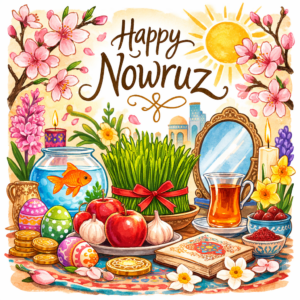
 In these very troubled times, we could all use a little hope and joy. The Persian New Year begins in Spring a time of rebirth and renewal.
Every year, as the last chill of winter loosens its grip, millions of people across Iran, Central Asia, the Caucasus, and diaspora communities worldwide pause to celebrate Nowruz — the Persian New Year marking the spring equinox. Rooted in Zoroastrian tradition and stretching back over three thousand years, Nowruz is far more than a calendar event. It is a living story, retold through ritual, gathering, and the quiet symbolism of a carefully arranged table. Before a single gift is exchanged or a single dish is served, Nowruz asks its celebrants to become storytellers.
At the heart of the holiday sits the haft-sin table — seven items beginning with the Persian letter “sin,” each one a chapter in a larger narrative about renewal and hope. The sprouts of sabzeh (wheat or lentil greens) speak of new beginnings; sib(apple) carries the ancient promise of health and beauty; somaq (sumac) foretells the sunrise after darkness. To set a haft-sin is to arrange a story about what it means to be human in a turning world. Elders pass down the significance of each item to children, grandchildren, and anyone willing to listen — so that the tradition itself becomes the vessel for cultural memory, crossing borders and generations without losing its meaning.
Nowruz has also inspired a rich body of storytelling in Persian literature. The great epic Shahnameh by the poet Ferdowsi — composed around 1000 CE — places the origin of Nowruz at the feet of the mythical king Jamshid, who is said to have ushered in a golden age of light and prosperity on the first day of spring. This story has been recited, illustrated, and performed for centuries, binding the holiday to the very idea of narrative itself. To celebrate Nowruz is, in some sense, to step inside a poem — to inhabit a story that insists the world can always begin again.
What makes Nowruz so enduring is exactly what makes all great storytelling endure: it holds something true. The spring equinox will come whether or not we mark it, but Nowruz transforms that astronomical fact into something felt — a shared exhale, a fire jumped over, a table set with seeds and mirrors, and the smell of something sweet cooking. In a fragmented modern world, the holiday reminds us that stories are not merely decoration. They are the architecture of belonging, the way communities hold themselves together across time. Nowruz is proof that the oldest stories, told faithfully enough, never really end. They endure.
No comment yet, add your voice below!