
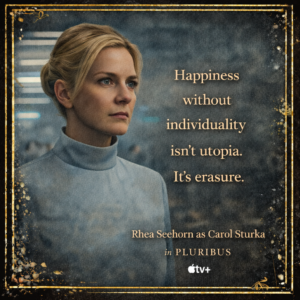
 She’s the most miserable person on Earth. And she might be the only one who can save it.
Pluribus (Apple TV+) poses one of the most unsettling questions in recent sci-fi:
What if happiness were the enemy?
Carol Sturka is a bestselling romance novelist who calls her own work “mindless crap.” She’s prickly, defensive, exhausted by the gap between what the world is and what it could be.
She is a textbook Power of Idealism Character Type.
And the force she’s up against — the serene, benevolent hive mind known as the Others — is something rarer still: a collective Power of Imagination Character Type.
The Power of Idealism Can’t Accept “Good Enough”
Power of Idealism characters are driven by a vision of how things could be. They measure the world against an internal ideal — and find it perpetually lacking.
Carol’s discontent didn’t start with the alien virus. It started long before. Her life looked like success from the outside, and felt like failure from the inside.
At her core, Carol prizes individuality and personal excellence above almost everything else. The right to struggle, to choose, to fail, to become — on your own terms. These aren’t just preferences for her. They’re the whole point of being alive.
When the Joining transforms humanity into a peaceful, contented collective, Carol doesn’t see liberation.
She sees the death of the self and everything that matters.
The Power of Imagination Lives Beyond the Ordinary
The hive mind — the Others — operates from a place no individual human consciousness can fully access.
Power of Imagination characters perceive wholeness, connection, and possibility ordinary individuals simply cannot see. They don’t live inside the limits of the everyday world. They exist in the space between — where everything is linked, everything is connected, and the boundaries of self dissolve.
The Others aren’t malevolent. They’re genuinely trying to help. Their peace is real. Their love is real.
That’s what makes them so terrifying to Carol.
What Gilligan Is Really Asking
Creator Vince Gilligan has been remarkably candid about the deeper question driving the show. He says he intentionally left open the possibility that becoming one of the Others might actually be fine — that the hive mind’s happiness isn’t obviously wrong.
But he also believes that the creative spark, the drive to make and struggle and author your own story, is one of the most precious things human beings possess. That when you surrender that agency — to a machine, to a collective, to anything that thinks for you — you lose a part of yourself.
Carol would agree. Violently.
Gilligan has also said he conceived the premise from a simple, devastating idea: a character who got everything they ever wanted — and that contentment immediately became the enemy of everything worth having. Because for a Power of Idealism character, arrival is never the point. The striving, the reaching is.
The Deepest Conflict Is Philosophical — And Personal
This isn’t hero vs. villain. It’s two fundamentally different answers to the question: What is a human life for?
The Power of Idealism says: for striving, for reaching beyond your grasp. For vision. For the painful, necessary work of becoming something better — as an individual, on your own terms.
The Power of Imagination says: for transcendence. For unity. For release from the prison of the separate self.
Carol’s deepest value — individuality — is exactly the thing the Others have surrendered. And they don’t miss it. They can’t even understand why she would.
She can’t accept a world where no one struggles toward anything alone.
The hive mind can’t understand why separateness would be preferable to peace.
Neither is wrong. That’s the point.
Vince Gilligan and Rhea Seehorn have built something extraordinary here — a show that uses Character Type conflict to ask what we lose when we stop wanting things to be different.
What’s your read on Carol — is her resistance heroic or self-destructive?


No comment yet, add your voice below!