
 Steve Jobs didn’t just build great products. He was possessed by a vision of what the world should be.
That’s not a metaphor. It’s the defining feature of a Power of Idealism character — and it explains everything about Jobs: his genius, his cruelty, his legendary “reality distortion field,” and the products that changed how we live.
The World As It Should Be
Every Power of Idealism character operates from a gap. They see the world as it is — mediocre, compromised, settling — and they are haunted by the world as it should be. That gap isn’t just an opinion. It’s a moral wound. It burns.
For Jobs, that gap was everywhere. In clunky computers with ugly interfaces. In phones with plastic keyboards. In music players that held 15 songs. In packaging that felt like an afterthought. He didn’t look at these things and think, that could be improved. He looked at them and thought, that is a betrayal of what this could be.
That’s the Power of Idealism engine. And once you see it, you can’t unsee it in everything Jobs did.
“Insanely Great” Was Never Hyperbole
Jobs famously refused to ship anything he didn’t consider insanely great. Designers at Apple have described presenting work that was technically excellent — and watching him reject it instantly, not because it was broken, but because it didn’t match the vision in his head. This is the Power of Idealism in full force.
Other Character Types negotiate with reality. They look at constraints — time, budget, engineering limits — and adapt. The Power of Idealism doesn’t negotiate. The vision is the fixed point. Reality has to move.
That’s where the “reality distortion field” came from. Jobs didn’t twist facts to manipulate people. He genuinely inhabited a version of reality where the ideal was achievable — and he pulled everyone around him into that reality whether they wanted to go or not. The result? The Macintosh. The iMac. iTunes. The iPhone. The iPad.
Products that didn’t just meet the market. They redefined what the market thought was possible.
The Pixar Years: When the Idealist Protects Other Visionaries
Here is something that surprises people about Steve Jobs: he bought Pixar in 1986 when it was a money-losing hardware company with a small animation division nobody believed in — and he kept it alive for nearly a decade before Toy Story proved everyone wrong.
That’s not the behavior of a businessman calculating returns. That’s a Power of Idealism character who saw something no one else could see yet. What Jobs recognized at Pixar was a concentration of people who refused to make anything less than extraordinary. Ed Catmull and John Lasseter shared his conviction that the gap between what animation was and what it could be was worth closing — no matter the cost or the timeline.
The Brain Trust — Pixar’s legendary creative feedback system, where directors and storytellers gave each other ruthlessly honest notes in service of the work — was the institutional expression of that shared idealism. It was built on a foundational belief that the story was sacred. That settling was not an option. That good enough was a failure of imagination.
Jobs didn’t run the Brain Trust. But he created the conditions that allowed it to exist. He absorbed years of losses and internal doubt because he believed — with the absolute certainty of a Power of Idealism character — that what Pixar was reaching for was real and worth reaching for.
This is one of the most revealing things about Jobs that most people miss: at Pixar, he learned to protect a vision that wasn’t entirely his own. He still held the standard. He still demanded excellence. But he also understood that other visionaries needed space to inhabit their own version of the ideal.
It may have been the most important lesson of his life. And it showed up in the later years at Apple — in the trust he extended to Jony Ive, in the design culture he built — as a hard-won sophistication that the younger, more tyrannical Jobs didn’t yet possess.
The Dark Side of the Vision
Power of Idealism characters pay a price for their gift — and so does everyone around them. When you are defined by the gap between what is and what should be, you have no patience for people who can’t see the vision or won’t commit to it completely. Jobs was famously ruthless — dismissing engineers in elevators, firing people on the spot, reducing grown adults to tears with a single withering assessment.
This wasn’t sadism. It was something more specific, and in some ways more frightening. To a Power of Idealism character, falling short of the vision isn’t just a mistake. It’s a betrayal. Of the work. Of the standard. Of what this could be. Jobs divided his world into geniuses and idiots — and the line could shift overnight. Someone who was a visionary one day was incompetent the next, because they had failed to hold the vision as sacred as he did.
That’s the Dark Side of this Character Type. The same uncompromising standard that produces breakthrough work can produce profound cruelty — because people stop being people and become instruments of the vision, or obstacles to it.
The Leader Who Could Not Delegate His Eyes
What made Jobs irreplaceable — and ultimately what made Apple struggle after his death — was that the Power of Idealism character cannot outsource the vision.
They are the vision. The standard lives inside them. No document, no brand guideline, no design system can fully capture it — because it is felt, not described.
Jobs once said that Apple’s most important resource wasn’t capital or patents. It was the concentration of talented people who refused to make anything less than excellent. He wasn’t building a company. He was building a container for the ideal.
That’s the Power of Idealism at its highest expression — and its deepest limitation. When Jobs was gone, the container remained. But the animating force was irreplaceable.
What This Means for Storytellers and Leaders
If you’re writing a Power of Idealism character, Steve Jobs is your template. Give them a vision so vivid and so real to them that they cannot understand why others don’t see it. Give them the capacity to inspire extraordinary devotion — and the capacity to wound without fully understanding the damage they’ve done. Let them build something genuinely beautiful.
And then ask what it costs them. Because the Power of Idealism’s arc is always the same: learning — sometimes too late — that the people around them are not instruments of the vision. They are the point.
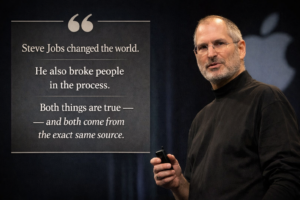
Steve Jobs changed the world. He also broke people in the process. Both things are true — and both come from the exact same source.
That’s what makes a Power of Idealism character so compelling, and so human.



No comment yet, add your voice below!