
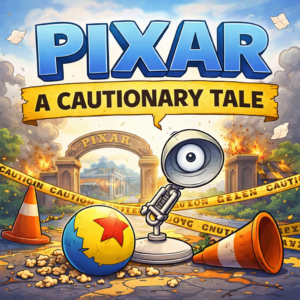
 Pixar — A Company Character Type® Case Study
The Pixar story is a cautionary tale, but it can be misread.
The lesson is not that one Character Type is superior and every company should aspire to it. The Power of Idealism is not better than the Power of Will. The Power of Conscience is not more virtuous than the Power of Ambition. Each type carries its own profound strengths, its own characteristic blind spots, and its own specific arc for growth.
The lesson is something more precise, and more transferable to any company trying to understand why it keeps succeeding, or why something it once had seems to have somehow slipped away.
The lesson is what happens when a company abandons its authentic Character Type and replaces it with one that serves different masters.
What Is a Company Character Type®?
Every company has one. Whether it knows it or not.
A Company Character Type is not a brand strategy, a mission statement, or a set of values posted in a lobby. Those are artifacts, expressions of a deeper operational reality that often has very little to do with how the company actually behaves when the pressure is on.
A Character Type lives in the instinctive question leadership returns to under pressure. The question that surfaces before the rational mind catches up — the one that reveals what the company actually believes about how the world works.
For Pixar under the Brain Trust, that question was: Is this the best it can possibly be? Not: Is this good enough? Not: Will this sell? Not: Can we ship this on the necessary release date?
Is this the best it can possibly be?
That is the signature question of Power of Idealism, and it shaped every decision Pixar made during its most consequential decade.
Power of Idealism: The Worldview
Companies operating from Power of Idealism are driven by the belief that an ideal exists, a version of the work that is true, complete, and fully realized. And that nothing ships until the team reaches it. Not approximates it. Reaches it.
This creates a culture that is, by definition, demanding. Sometimes brutal. The standard is internal, not external. Market research doesn’t define it. Positive test screenings don’t validate it. The standard is set by people who know what the work is capable of being, and who refuse to release it until it gets there.
The great strength of Power of Idealism is that it produces work no one else produces. Not because the team is more talented, though they often are. But because the team will do things other companies won’t, including tearing apart nearly finished work and starting over rather than releasing something that falls short. Even if you miss the Christmas movie deadline.
The commercial shortcut is always available. The Power of Idealism company walks away from it.
The characteristic dark side of Power of Idealism is perfectionism that becomes paralysis. The standard can become so internal, so self-referential, that the company loses touch with the audience it’s making work for. The ideal becomes an end in itself rather than a vehicle for connection.
Pixar under the Brain Trust came close to this edge more than once. What kept them from falling over it was the insistence on emotional truth, the belief that the ideal they were pursuing was not aesthetic perfection but emotional honesty. That kept them tethered to the audience even when the production process was at its most extreme.
The Brain Trust: Power of Idealism at Its Highest Expression
To understand what Pixar was at its peak, you have to understand how it made decisions.
The Brain Trust — John Lasseter, Pete Docter, Andrew Stanton, Lee Unkrich, and a small circle of senior creative leaders — operated as a creative advisory body with a specific, unusual function. They watched films in progress and gave notes. But the director was under no obligation to take those notes.
This seems strange until you understand the logic: if the director follows notes without internalizing them, the film becomes collaborative mush. The Brain Trust’s job was not to impose solutions. It was to identify problems with such precision and honesty that the director was compelled to solve them in their own way.
That is Power of Idealism operating as a system rather than a personality.
The most famous demonstration of this commitment came during the production of Toy Story 2. The film had been conceived as a direct-to-video sequel, a format that, at the time, was essentially a cash-generation exercise with lower creative standards. Partway through production, the Brain Trust watched what existed and concluded it was not good enough. Not bad for a direct-to-video sequel. Not good enough, full stop.
They pulled it from the direct-to-video track.
They rebuilt the entire film from scratch, in nine months, under nearly impossible production pressure, to meet the theatrical standard.
The commercial shortcut was right there. They walked away from it.
The result was a film critically considered superior to the original, and one of the most technically and emotionally accomplished animated films ever made. That is what Power of Idealism at its highest expression produces.
The Disney Acquisition: When the Operating Question Changes
The Disney acquisition of Pixar in 2006 did not immediately alter the output. For several years, the Brain Trust continued to function. The system continued to produce extraordinary work. Up, WALL-E, and Toy Story 3 all came after the acquisition, and all represent the Power of Idealism operating at its fullest power.
But the operating conditions had changed. And changed conditions, over time, change operating questions.
Disney did not acquire Pixar because it loved cinema. It acquired Pixar because Pixar’s films produced merchandise, theme park attractions, sequels, and franchises at a scale Disney’s own animation division had failed to achieve for years. The acquisition was a transaction between the Power of Ambition, Disney’s core operating type, and the Power of Idealism.
Power of Ambition operates from a different question than Power of Idealism. Its question is not: Is this the best it can be? Its question is: Will this sell? Will this build the franchise? Will this extend the brand?
These questions are not inherently wrong. Companies operating from Power of Ambition build remarkable things. But they are incompatible questions. You cannot serve both masters simultaneously. At some point, when the two questions conflict, one wins.
After the acquisition, the operating question gradually shifted. From ‘Is this the best it can be?’ to ‘Will this sell?’
The shift was not announced. It rarely is. It showed up in the projects that got approved — a fourth Toy Story, a second Cars, sequels to properties that had resolved cleanly and completely. It showed up in production timelines that no longer allowed for the kind of wholesale rebuilds the Brain Trust had once insisted upon. It showed up in the gradual restructuring of creative authority.
The production values stayed high. The marketing stayed brilliant. The voice casts stayed luminous. But something had changed.
Inauthenticity Has a Scent
The most devoted audiences are always the first to detect the counterfeit.
Not because they can articulate what changed. Most cannot. They will say things like the magic isn’t there anymore, or it feels like it’s going through the motions, or it’s fine but it’s not Pixar. None of those are precise diagnoses. But they are accurate ones.
What audiences detect, what they cannot name but cannot miss, is the presence or absence of the animating question.
When a film is made under Power of Idealism, every creative decision is in service of the ideal. The emotional truth of a moment. The specific, irreducible humanity of a character. The scene that isn’t required by the plot but is required by the truth. You feel that commitment in the finished work even when you can’t identify its source.
When a film is made under Power of Ambition, every creative decision is in service of the franchise. The callback that rewards returning audiences. The emotional beat timed to the third-act convention. The ending calibrated to leave room for a sequel. You feel that calculation too, even when the execution is technically flawless.
Toy Story 3 earns its tears. Toy Story 4 manufactures them. The difference is not craft. The difference is the question the creators were answering when they made it.
The most devoted audiences gave themselves most completely to the real thing. That is why they are the most sensitive instruments for detecting when it is gone.
This Isn’t Just a Pixar Story
The Pixar story is recognizable because the brand is beloved and the decline is documented. But the pattern it illustrates is not specific to Pixar, to animation, or to entertainment.
It happens when a consulting firm built on intellectual rigor gets acquired by a company optimizing for billable hours. It happens when a family-owned retailer built on community trust gets acquired by a private equity firm optimizing for margin. It happens when a newspaper built on investigative journalism gets acquired by a company optimizing for clicks.
The acquiring entity does not destroy the company’s Character Type out of malice. It destroys it out of incomprehension. It doesn’t understand that the Character Type is not a policy or a cultural quirk or a leadership preference. It is the operational logic of the company. It is the thing the company actually is. Remove it, and what remains looks like the original from the outside, same brand, same people, same products, but is something entirely different from the inside.
The symptoms are always the same: the quality holds for a period, then gradually degrades. The core audience detects the change before the metrics confirm it. Leadership responds with increased marketing rather than increased investment in the creative conditions that produced the original work. The audience drifts further. The metrics decline. Leadership concludes the brand has run its course.
The brand hasn’t run its course. The Character Type has been abandoned. Those are not the same thing.
What This Means for Your Company
If you are building a company, the most important question you can ask is not what type you want to be. It is what type you already are.
Character Type is not aspiration. It is operational reality. It shows up in the decisions your leadership makes under pressure, not the decisions they plan to make, or want to make, or describe in strategy documents. The actual decisions. The ones that happen fast, when the stakes are real and the shortcuts are available.
What question do you keep returning to? For example:
Is this right, is this for the greater good? That is the question of Power of Conscience.
Is this crushing the competitors? Power of Will. (My next “white paper” is an analysis of Amazon).
Is this uniquely ours, is this authentic, is this the real thing, the truest emotion? Power of Idealism.
Will this advance us? Power of Ambition.
What does this tell us that we didn’t know before? Power of Truth.
Once you know your type, two things become available to you that were previously inaccessible. First: you can understand your characteristic blind spots, the failure modes that are structurally predictable given your type, not random bad luck. Second: you can understand your arc, the specific growth your type requires in order to become its highest expression rather than its dark side.
Pixar’s arc, the life lesson Power of Idealism requires, is learning that the ideal is not an end in itself. It is a vehicle for connection. The standard exists to serve the audience, not to prove something to the team. When that tether holds, the work produced under Power of Idealism is among the most profound and lasting that any human organization can create.
When it breaks, when the ideal becomes self-referential, or when it is replaced entirely by the calculating question of what will sell, something irreplaceable is lost. Authenticity, then, is no longer the goal.
You cannot simply decide to have a different Character Type. But you can decide to honor the one you have, or neglect it. And the results of that choice are legible in every frame of every film Pixar has ever made.


No comment yet, add your voice below!