
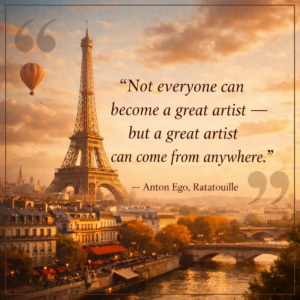
 Anton Ego doesn’t know he’s about to be humbled.
He arrives at Gusteau’s restaurant that night as the most feared critic in Paris — thin, cold, and certain of his own taste and discernment. He has spent a career deciding who belongs and who doesn’t. Who has merit and who is merely pretending. And, now, he has been wrong in the most spectacular way imaginable.
A rat has out-cooked everyone in the kitchen.
By the end of Ratatouille, Ego doesn’t just revise his review. He revises himself. He writes the most honest words of his career: “Not everyone can become a great artist, but a great artist can come from anywhere.”
That line isn’t just a satisfying ending to an animated film. It’s a precise diagnosis of the single greatest mistake organizations make when they build teams, hire talent, and decide who gets a seat at the table.
The Gusteau Problem
Auguste Gusteau’s famous motto — “Anyone can cook” — was mocked by the establishment as naïve populism. Food critics like Ego saw it as a lowering of standards, a sentimental lie told to flatter the unqualified.
But Gusteau wasn’t saying everyone produces excellent work. He was saying that excellence doesn’t live where you expect it to.
This is the core insight that Diversity, Equity, and Inclusion rests on — and it’s not a political idea. It’s a competitive one.
When organizations draw their talent from a narrow pool defined by familiarity, tradition, and the comfortable assumption that greatness looks a certain way, they are making the same mistake Anton Ego made. They are confusing access with ability. They are selecting for people who resemble the last successful person, rather than selecting for the quality that actually drives success.
What “Anywhere” Actually Means
The word that matters in Ego’s quote isn’t “great.” It’s anywhere.
Anywhere means different backgrounds. Different life experiences. Different ways of seeing the same problem. Different assumptions about what’s possible and what’s been done before.
This is not charity. This is strategy.
Research on team performance consistently shows that groups with diverse perspectives — people who don’t all share the same blind spots — outperform homogeneous groups on complex, creative, and adaptive problems. The reason is structural: when everyone in the room was trained in the same tradition, educated in the same institutions, and shaped by the same cultural assumptions, they generate the same solutions. They are excellent at refining what already exists. They are poorly equipped to imagine what doesn’t yet exist.
Remy wasn’t admitted to Gusteau’s kitchen. He had to hide. He had to work through a human intermediary just to have his talent registered at all. And the restaurant — and ultimately Ego himself — was transformed by what that excluded perspective made possible.
The Current Backlash Is a Familiar Story
We are living through a moment of organized retreat from DEI commitments. Companies are quietly dismantling programs. The acronym itself has become politically charged. The argument being made, in various forms, is that DEI represents the triumph of identity over merit — that it rewards people for being the right kind of person rather than the best person for the role.
This argument would be more persuasive if organizations had actually been selecting purely on merit before DEI existed.
They weren’t. They were selecting on familiarity, on network access, on the kind of “culture fit” that is often just a polite name for resemblance. They were selecting people who went to the right schools, knew the right people, and moved through the world in ways that felt legitimate to whoever was doing the hiring.
Ego’s restaurant world had the same problem. The critics, the institutions, the gatekeepers — they weren’t protecting quality. They were protecting a definition of quality that happened to exclude the people they didn’t expect to see.
Greatness Is Not a Comfortable Process
Here’s what Ratatouille doesn’t flinch from: Remy’s presence in that kitchen is deeply disruptive. Linguini can barely hold himself together. The staff is confused. The system wasn’t built for what’s happening. It requires Colette, the most disciplined and skilled human chef in the kitchen, to extend trust she has never been asked to extend before.
Real inclusion is like this. It is not a smooth process of adding new faces to an unchanged system. It requires the system itself to become more flexible, more honest about what it values and why, and more willing to be surprised.
That is uncomfortable. It is also, when organizations have the nerve to see it through, transformative.
The Lesson Ego Learns
What makes Anton Ego one of the most interesting characters in Pixar’s catalog is that he doesn’t just tolerate his humbling — he receives it. He allows the experience to rewrite him. He closes his prestigious column and opens a small bistro where Remy’s food is served. He trades prestige for something better: genuine talent, taste, and discernment.
That’s the offer DEI actually makes to organizations willing to take it seriously. Not the performance of inclusion. Not the checkbox. But a genuine expansion of who gets to contribute — and what becomes possible when they do.
Not every company will have the courage to take that offer right now.
But the great ones can come from anywhere.



No comment yet, add your voice below!