
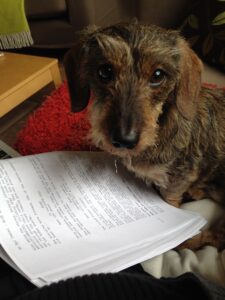
 Excerpted from “Writers and Their Dogs,” Eating My Words (eatingmywords.com.au)
The writing life is, by its very nature, a solitary one. It demands long hours cooped up alone, locked in a fraught negotiation with the page — one shadowed by self-doubt and cut off from easy human connection. Which is exactly why so many writers have found their most essential companion not in other people, but in a dog.
As author Helen Humphreys has observed, the intimacy a dog offers may be uniquely suited to a writer — because while closeness with other people so often draws a writer away from their work, closeness with a dog tends to bring them back toward it. Eating My Words
The history of literature bears this out. Virginia Woolf had her mongrel terrier Grizzle, adopted from the Battersea Dogs’ Home, who appears in her diaries as a kind of creative touchstone. “And the truth is, one can’t write directly about the soul,” Woolf wrote. “Looked at, it vanishes: but look at the ceiling, at Grizzle … and the soul slips in.” Eating My Words
Gertrude Stein — who left behind some of the most memorable writing about dogs in the literary canon — understood this reciprocal dependency well. The dog needs the writer. The writer needs the dog. And something about being needed by another creature unlocks the imagination in ways that solitude alone cannot. Eating My Words
There is also the matter of perspective. Living alongside a dog — introducing them to the world, seeing familiar things through their alert, unguarded eyes — has a way of making the world feel new again. And that renewal is something every writer, however experienced, desperately needs. Eating My Words
NOTE FROM LAURIE– At ETB Screenwriting, we talk a lot about the foundation of great storytelling: knowing your characters from the inside out. But that kind of deep observation doesn’t begin at the keyboard. It begins in the world — in the habit of paying close attention to other living beings, noticing how they move through space, what they want, what they fear, how they love. A dog, it turns out, is one of the best teachers of that skill you’ll ever have. They live their inner life openly, moment to moment, without artifice or agenda. Watching them is, in the truest sense, character study.
So if you’re stuck — on a scene, on a character, on the page itself — maybe the answer isn’t more time at your desk. Maybe it’s a leash and a walk around the block.
Read the full article at eatingmywords.com.au
No comment yet, add your voice below!