
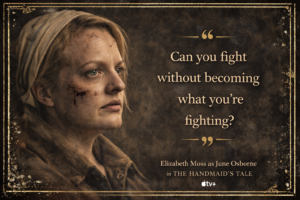
 I am a big fan of The Handmaiden’s Tale and the newly released Testament. It’s all about character for me.
June Osborne doesn’t survive Gilead. She wages war against it. That distinction is everything when analyzing her as a Power of Conscience Character Type.
Most people trapped in an oppressive system find ways to cope — to endure, to adapt, to minimize damage. June cannot do that. Not because she’s reckless. Because her Character Type won’t allow it.
The Power of Conscience is driven by a moral imperative. Their worldview is built on a bedrock belief in right and wrong, justice and injustice — and the non-negotiable conviction that someone has to do something about it. When that someone is the only person in the room, it has to be them.
In Gilead of The Handmaiden’s Tale, June’s Mask is compliance. She wears the red. She speaks the approved phrases. She performs submission with enough skill to stay alive. But her inner life is a constant, burning indictment of everything around her.
This is the defining tension of the Power of Conscience Character Type. They are not naive. They understand power. They understand consequence. They know the cost of resistance — and they pay it anyway.
June’s Strongest Traits are moral courage, fierce protective instinct, and an almost terrifying clarity about what she will and will not accept. These traits make her dangerous to Gilead in a way that brute force never could be. She doesn’t just want to escape. She wants to dismantle.
But the Power of Conscience has a shadow side. Their Trouble Traits begin to surface under sustained moral crisis: self-righteousness, the belief that the importance of the cause justifies any method, the slow erosion of the very principles that drove them in the first place.
And June’s Dark Side is one of the most honest portrayals on television. She becomes capable of cruelty. Of calculated violence. Of sacrificing anyone on the altar of the mission. She looks in the mirror and begins to see Gilead’s logic looking back at her — repackaged as justice.
That is the arc lesson for the Power of Conscience: the means you use become the ends you build. You cannot burn down an evil empire and emerge uncorrupted if you burn it down with cruelty.
June’s journey forces the central question her Character Type must always answer: Can you fight without becoming what you’re fighting? The most powerful Power of Conscience characters don’t just resist oppression. They hold the line inside themselves — even when no one is watching, even when it costs them the mission, even when righteous fury feels indistinguishable from justice.
June is still learning that lesson. And that’s exactly what makes her one of the most compelling characters in prestige television today.
What Power of Conscience characters have you seen walk that razor’s edge — between moral courage and moral compromise?


No comment yet, add your voice below!