
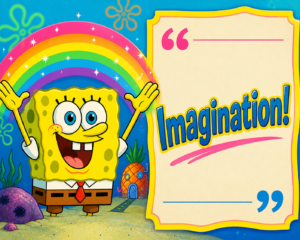
 SpongeBob SquarePants has been on the air for 26 years.
That’s not an accident.
Most people think SpongeBob is popular because he’s silly. Or because kids love cartoons.
But there’s something deeper happening — and it explains why adults quote this show, why it became a meme empire, and why it still generates over $13 billion in merchandise revenue annually.
SpongeBob is a Power of Imagination character. And they are vanishingly rare on television.
What makes a Power of Imagination character?
They don’t just have enthusiasm. Enthusiasm is their operating system.
SpongeBob wakes up every single morning and believes — with his whole body — that today will be magnificent. Frying Krabby Patties isn’t a job. It’s a calling. Jellyfishing isn’t a hobby. It’s pure, transcendent joy.
His imagination isn’t escapism. It’s how he makes sense of reality.
When the world resists him — and Squidward resists him constantly — SpongeBob doesn’t become cynical. He doesn’t strategize. He doesn’t retaliate.
He just… keeps believing. Keeps creating. Keeps inviting everyone around him into the wonder he sees.
That’s why we can’t look away.
Power of Imagination characters remind us of something we’ve buried.
The part of us that once thought a cardboard box was a spaceship. That stayed up all night on a creative project for the sheer love of it. That genuinely couldn’t understand why everyone else wasn’t as excited as we were.
SpongeBob isn’t naive. He’s awake in a way most characters aren’t.
The dramatic irony of his world is devastating in the best way:
Squidward wants to be seen as an artist. SpongeBob already is one — he just doesn’t need anyone to confirm it.
That gap between what characters want and what they are is where great storytelling lives.
And the Power of Imagination type makes that gap visible like no other.
If you write characters who are optimistic, enthusiastic, and creative, ask yourself:
Is their joy earned by who they are? Or is it just a personality trait you’ve slapped on top?
SpongeBob works because his imagination is his worldview. It shapes every choice, every relationship, every mistake, every comeback.
That’s a Character Type. Not a quirk.

No comment yet, add your voice below!