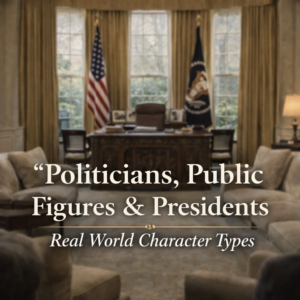
Politician, Public Figures & Presidents – Nine Character Types

Real-world public figures reveal exactly how Character Types drive story


There’s a reason political dramas dominate prestige television. From The West Wing to Succession to House of Cards, audiences are endlessly fascinated by the machinery of power — who holds it, who loses it, and what it costs.

But what makes a political character truly unforgettable on screen isn’t the policy debate or the backroom deal. It’s the internal engine driving every decision they make. That internal engine is Character Type.

Real-world presidents, politicians, and public figures are among the best teaching tools a screenwriter has. Why? Because we know their histories. We’ve watched them succeed and fail in public. We’ve seen their blind spots play out on a global stage. We don’t have to guess — we know their story.

Here’s what studying them can teach you about writing characters that feel genuinely alive.


The World View Is Everything

Every Character Type operates from a distinct philosophy of life — a lens through which all experience is filtered. This isn’t a trait or a personality quirk. It’s the bedrock assumption a person carries about how the world works and what they must do to survive and thrive in it.

Consider Abraham Lincoln. His entire political life was shaped by a belief in moral truth as the ultimate arbiter of action. He moved slowly, agonizingly, toward decisions — not because he was weak or indecisive, but because the weight of what was right had to be felt fully before he could act on it. When he finally did act, he acted with the unshakeable conviction of someone who had done the moral calculus and arrived at bedrock.

That’s a writer’s gift: a character whose deliberation is the drama.

Contrast this with Lyndon Johnson. LBJ’s world view was built around power and leverage — the belief that power is the mechanism through which anything of lasting value gets accomplished, and that reluctance to use power is a kind of moral failure. His mastery of the Senate, his relentless arm-twisting, his almost physical need to dominate a room — these weren’t personality excesses. They were expressions of a coherent philosophy about what it takes to actually change things rather than merely stand for them.

Two men who both wanted justice. Radically different ideas about how justice is achieved. That tension — at the level of world view — is the raw material of compelling drama.


Fear Drives the Dark Side

One of the most powerful tools in the Nine Character Types® framework is the relationship between a character’s core fear and their Dark Side behavior. When the fear is activated, the strengths that define them can curdle into something destructive — and still be entirely recognizable as them.

Richard Nixon is a case study in this dynamic. Brilliant, strategic, capable of genuinely consequential statecraft — and yet undone by a fear of being outmaneuvered, humiliated, exposed as less than. The very intelligence that made him effective became the instrument of his self-destruction. He didn’t need to bug the Watergate. He was already winning. But the fear didn’t care about the odds. It spoke louder than the evidence.

For screenwriters, this is the lesson: your character’s Dark Side isn’t a different person. It’s the same person, operating from fear rather than strength. The behavior looks different, but the internal logic is continuous. Nixon paranoid is still Nixon. That coherence is what makes a villain — or a tragic hero — feel true.


The Life Lesson Shapes the Arc

Character arc isn’t just change. It’s specific change — the kind that can only happen when a character confronts and works through the particular lesson their Character Type demands of them.

Consider Barack Obama through this lens. His public story is shaped by an extraordinary capacity for reason, synthesis, and long-horizon thinking. He consistently sought to hold competing perspectives simultaneously, to find the analytical framework that could contain apparent contradictions. At his best, this produced legislation, diplomacy, and rhetoric of genuine complexity and craft.

But the Life Lesson that shadows that strength is the peril of analysis as avoidance — the risk that the search for the perfect framework becomes a way of deferring the costs of direct confrontation. Critics from across the political spectrum, for very different reasons, often landed on a version of this critique: that the elegant formulation sometimes substituted for the harder act.

Whether you agree with that assessment politically isn’t the point. The point is that this tension — between the genuine strength and the growth edge — is exactly the kind of internal conflict that drives a character arc. Not an external obstacle. An internal one.


What This Means for Your Script

When you’re building a political character — a senator, a press secretary, a campaign manager, a president — the research question isn’t what did they do? It’s why did that feel necessary to them?

Study the public figures who share your character’s worldview. Read the biographies not for the events, but for the internal logic connecting the events. Look for the moments where strength tipped into self-sabotage, where fear spoke louder than wisdom, where the Life Lesson was almost learned — and wasn’t.

That’s where your script lives.

Political drama at its best isn’t about power. It’s about what people become in pursuit of it — and whether they can find their way back to who they actually are.

The world’s stage has given you an extraordinarily well-documented cast to learn from. Use them.

Pamela Harrington – Power of Truth Diplomat

Pamela Harriman, the British-born socialite who became one of Washington’s most influential political powerbrokers and served as U.S. Ambassador to France under President Clinton, embodied the Power of Truth Character Type in ways that shaped American politics for decades. She wasn’t a politician herself—she was something far more powerful: the person politicians came to for access, funding, and strategic counsel. She was the advisor, the confidant, the keeper of secrets who understood that real power operates behind the scenes, through relationships built on trust and the strategic sharing of confidences.

The Secret Keeper and Strategic Connector

Harriman’s genius lay in her understanding that nothing in politics is what it seems on the surface. Born Pamela Digby in 1920, she married into Churchill’s family during World War II, then later wed Averell Harriman, the wealthy American diplomat and Democratic power player. But her real influence came from her ability to investigate beneath the surface of political life—to understand who really held power, what they really wanted, and how to connect the right people at the right moment. She operated from the classic Power of Truth worldview: everyone has hidden agendas, all political relationships are transactional, and the person who understands the hidden dynamics controls the game.

Her famous Georgetown salon became legendary precisely because it functioned as a Power of Truth operation. She didn’t just throw parties—she curated strategic gatherings where rising Democratic politicians, wealthy donors, foreign dignitaries, and power brokers could connect away from public scrutiny. She asked the questions others didn’t think to ask: “What do you really need? Who do you really need to know? What’s the obstacle no one’s talking about?” She investigated people’s true motivations, their hidden vulnerabilities, their secret ambitions—and then strategically connected them with others who could help or who needed help. She was building a network based on confidences, creating an “us vs. them” dynamic where being inside Pamela’s circle meant access to power that outsiders could only dream of.

The Power of Truth Strategic Approach

Harriman exemplified the Power of Truth Character Type’s strategic embrace—moving toward people to build relationships that served larger goals. She didn’t command or demand; she cultivated. She made powerful men feel understood, wealthy donors feel essential, young politicians feel valued. She shared secrets to demonstrate trustworthiness, created intimacy through confidential conversations, and built loyalty by making people feel they were part of an inner circle that understood how things really worked. As the Nine Character Types® framework explains, Power of Truth characters “gain alliances through shared confidences and demonstrations of their own trustworthiness, loyalty and commitment.” Harriman mastered this completely.

Yet she also embodied the Power of Truth character’s contradictions. She needed to embrace others—building the relationships that gave her influence—while maintaining enough distance to see clearly, to calculate, to avoid being used herself. She investigated everyone (what’s their real agenda?) while presenting herself as the ultimate insider who could be trusted with anything. She built her power on being the advisor rather than the leader, more comfortable behind the scenes than in the spotlight, which is classic Power of Truth leadership style. Politicians came to her for counsel, donors came to her to understand where to place their bets, and everyone came to her because she knew what was really happening beneath Washington’s public performances.

Ambassador to France: The Perfect Role

When Clinton appointed Harriman as Ambassador to France in 1993, it was the perfect culmination of her Power of Truth journey. Diplomacy itself is a Power of Truth profession—nothing is what it seems, everyone has hidden agendas, relationships are built on strategic trust while maintaining skeptical distance. Harriman excelled at reading the room, understanding what the French really wanted versus what they said they wanted, building relationships with French officials while loyally serving American interests. She investigated beneath diplomatic niceties to find real leverage points. She used her legendary social skills to create informal channels where real negotiations could happen away from formal structures.

The Kingmaker’s Worldview

Harriman lived the Power of Truth worldview completely: life is a minefield where you must suspect everyone’s motives, trust carefully, and understand that all agendas are hidden. But unlike Power of Truth characters who fall into paranoid isolation, Harriman channeled this understanding productively. She didn’t withdraw from the political game—she mastered it by accepting its rules. She didn’t rage against the fact that politics operates through hidden deals and secret relationships—she became the person who facilitated those deals and built those relationships. She accepted that “maybe” was the best you could get in politics: maybe this candidate will win, maybe this policy will pass, maybe this relationship will prove valuable. She hung her entire influential life on those “maybes” and became one of the most powerful women in American politics without ever running for office herself.

Pamela Harriman died in 1997 while still serving as Ambassador, collapsing at the Ritz Paris pool—a fitting end for someone who spent her life at the intersection of power, diplomacy, and strategic relationships. She proved that the Power of Truth Character Type can thrive in the real world when you use your investigative instincts, your understanding of hidden dynamics, and your strategic relationship-building not for paranoid withdrawal but for creating genuine influence. She was the advisor every politician needed, the confidant everyone trusted, the keeper of secrets who never betrayed a confidence—and in being all those things, she became the kingmaker who shaped American politics from behind the scenes, exactly where Power of Truth characters are most comfortable and most powerful.

My Newsletter – Power of Truth

I AM BACK

I collapsed under the overwhelming weight of updating and keeping the website current, and took it all down. I was so gratified by how many of you wrote to me about missing this resource. I know it’s controversial, but AI saved me. It automated processes that I couldn’t handle on my own. Never fear. The content and analysis are all mine.  etbscreenwriting.com is back with fresh content every few days. I am currently updating The Power of Truth book, so I am concentrating on those character examples. But all the previous eBooks are back online.

The Power of Truth Character Type

What is a Character Type? Character Type determines how a person views the world, sees his or her place in it, and develops a philosophy of life and love, Character Type creates innate strengths and weaknesses and determines the lessons to be learn over the arc of the story. An archetype is a job (mentor, wizard, trickster, etc.) Character Type determines how someone does their job in story and why they do it.

Power of Truth characters go where others fear to tread in whatever job they do. They poke and prod, never believing what’s on the surface of things. They fear being unable to distinguish truth from lies or being unable to spot or prove cover-ups, conspiracies, hidden pitfalls, or the secret agendas of others. They suspect and try to detect what someone’s real motives might be or what is hidden from an initial or superficial assessment of a situation.

The past three years have seen an explosion of Power of Truth characters across television and film, reflecting our cultural moment of institutional distrust, conspiracy awareness, and reality fragmentation.

These aren’t just detectives solving crimes—they’re investigators questioning the nature of truth itself in a world where everyone seems to have hidden agendas, where news might be fake, where surveillance is ubiquitous, and where even your own memories might be unreliable.

Television has given us particularly compelling Power of Truth characters who investigate week after week as their paranoia deepens with each revelation.

Charlie Cale in Peacock’s Poker Face may be the most literal Power of Truth character ever created—Natasha Lyonne plays an itinerant casino worker with the supernatural ability to detect when anyone is lying to her. This makes her the perfect investigator and the loneliest person alive. Read more HERE.

Netflix’s The Diplomat brings the Character Type into international politics. Keri Russell’s Ambassador Kate Wyler investigates a massive conspiracy while trying to determine whom she can trust within her own government, including even her husband. Read more HERE.

HBO’s The Penguin shows the darkest version of the Character Type in Colin Farrell’s Oz Cobb. Cobb is a Gotham crime boss who trusts absolutely no one and strategically builds relationships he’s already planning to betray—the Power of Truth character fallen completely to the Dark Side, where paranoia and disloyalty become a self-fulfilling prophecy. Read more HERE.

Recent films have explored the Power of Truth Character Type through both epic and intimate lenses.

Denis Villeneuve’s Dune: Part Two transforms the Character Type into mythic tragedy. Timothée Chalamet’s Paul Atreides investigates his own destiny through prescient visions that reveal countless possible futures—which end in betrayal and catastrophe. This creates the ultimate Power of Truth nightmare: having access to the truth about what’s coming and still being unable to prevent the worst of it. Read more HERE.

The horror film Longlegs features Maika Monroe as FBI agent Lee Harker investigating a serial killer, only to discover disturbing connections to her own past and the possibility that her investigative abilities might have a supernatural source. Read more HERE.

These characters proliferate because we’re living through an era that validates Power of Truth paranoia. Institutional betrayals have proven real (government surveillance, criminal cover-ups, political conspiracies), reality itself seems fragmented (deepfakes, misinformation, social media manipulation), and the question “What’s really happening?” has become a matter of survival rather than neurosis.

It’s good to be back.  I’ve missed you!

Get The Power of Truth eBook. HERE

Nuremberg x Two

The Trial That Never Ends:
What Two Nuremberg Films Reveal About the Nine Character Types®


Both films are set in the shadow of the same courtroom. Both are serious, prestigious works about Nazi war crimes and the reckoning that followed.

Yet Judgment at Nuremberg (1961) and the 2025 Nuremberg — James Vanderbilt’s psychological thriller with Russell Crowe and Rami Malek, now streaming on Netflix — feel so radically different that viewers sometimes wonder if they belong to entirely different genres.

They do. The difference is the Character Type at the dramatic engine of each film. Once you see it, you understand everything — including why the 2025 film ends not with a verdict, but with a suicide.


The Dramatic Engine Is Everything

In the Nine Character Types® framework, the Character Type powering the protagonist determines the story’s central question, the nature of conflict, and what kind of truth the audience walks away carrying.

Power of Truth characters are driven by a need to perceive what is genuinely real, no matter the cost. Their stories ask: what is true when truth requires something unbearable of us?

Power of Reason characters are driven by a need to understand — to find the system, the logic, the explanation. They believe the world makes sense if you analyze it correctly. Their stories ask: can this (evil) be understood? And what happens to the person who tries to make the world understand?

Same courtroom. Completely different dramatic souls.


Judgment at Nuremberg (1961): The Power of Truth Story

Stanley Kramer’s film is, at its core, a Power of Truth drama — and Spencer Tracy’s Judge Dan Haywood is its engine.

Haywood arrives in Germany as a genuine outsider: a modest judge from Maine with no political agenda and no personal stake in the verdict. His worldview is simple and devastating. He will look at what actually happened. Not at what is convenient to believe, not at what the State Department needs for Cold War optics, not at what the charming German social world wants him to see. He needs to understand what is genuinely true about what occurred in this courtroom — and why.

This is the hallmark of a Power of Truth Character Type in action. They cannot be bought or managed, not because they are morally superior, but because they are constitutionally incapable of accepting a false picture of reality.

Against him stands Hans Rolfe — Maximilian Schell in his Oscar-winning performance — a Power of Reason Character Type and the perfect intellectual foil. Rolfe’s defense is technically brilliant. He doesn’t deny the crimes. He constructs a logical argument that distributed culpability so widely — to the Allies who signed treaties with Hitler, to American eugenicists who inspired Nazi law — that individual guilt becomes philosophically untenable. Every argument is technically airtight. Every argument is profoundly, spiritually empty.

Haywood’s arc isn’t about defeating Rolfe’s logic. It’s about recognizing the limit of logic as a path to truth. He doesn’t out-argue Rolfe. He simply refuses to accept that a technically valid argument constitutes reality.

Then there is Ernst Janning — Burt Lancaster — the film’s hidden heart. Janning is a Power of Conscience Character Type: a man of genuine moral conviction who compromised himself incrementally, who collaborated through silence and passivity rather than enthusiasm and belief. His shattering courtroom confession is the Power of Conscience’s defining journey — the long, costly return to alignment with values he never actually abandoned, only betrayed.

The lesson for writers: A Power of Truth protagonist doesn’t drive action through plot mechanics. They drive it through presence and clear seeing. Haywood’s willingness to look directly at what happened forces every other character to either tell the truth or reveal themselves in the act of hiding it.


Nuremberg (2025): The Power of Reason Story

Here is where the 2025 film makes its radical departure — and where the Nine Character Types® framework reveals exactly why this film had to end the way it does.

Rami Malek’s Douglas Kelley is a Power of Reason Character Type, and the film is his story. Kelley arrives at Nuremberg as a U.S. Army psychiatrist with a clear, logical mission: evaluate the mental status of the Nazi defendants, determine whether they are fit for trial, and in doing so, crack the code of evil. His worldview is the worldview of Reason at its most confident — if we can understand something, we can prevent it from happening again. Evil, to Kelley, is a problem to be diagnosed.

What he finds is the thing that destroys him.

Göring is not insane. He is not a monster in any clinical sense. He is intelligent, charming, strategically brilliant, and fully sane by every metric. He chose this. Ordinary sanity enabled extraordinary atrocity. The Power of Reason’s promise — that understanding leads to prevention — cannot survive this discovery.

And Russell Crowe’s Göring, a masterclass in Power of Will, is the perfect antagonist for a Power of Reason protagonist. The Power of Will without moral compass is among the most terrifying Character Types to place on screen. Göring treats the entire trial as a chess match he intends to win even from a prison cell. He coaches the other defendants. He manages his own image for posterity. He grants Kelley access not out of cooperation but out of control — every conversation is Göring’s opportunity to dominate the frame. He ultimately takes his own life rather than allow the Allies the satisfaction of the hangman.

Notice the structural perfection of this opposition. Kelley’s Power of Reason strength is analysis and systematic understanding. Göring’s Power of Will strength is dominating the present, bending every situation to his advantage. Kelley wants to understand Göring. Göring wants to use Kelley. And Göring, in the film’s devastating logic, wins.

The film’s intertitles deliver the verdict: Kelley returns to the United States, publishes his book, (which fails) descends into alcoholism, and in 1958 — thirteen years after Nuremberg — takes his own life by swallowing cyanide. The same method Göring used. The film doesn’t explain this. It doesn’t need to. The Power of Reason protagonist stared into the mechanism of evil long enough to absorb it.

This is the dark arc that the Nine Character Types® framework predicts for Power of Reason characters when they go wrong. Logic divorced from moral grounding doesn’t protect you. It creates a kind of intellectual fascination that can override self-preservation entirely. Kelley wanted an answer. He got one. The answer was unbearable. No one cared.

The lesson for writers: A Power of Reason protagonist in a dark arc doesn’t fail because they’re wrong. They fail because they’re right — and the truth they discover is one that reason alone cannot metabolize. The horror isn’t madness. It’s clarity.


What the Comparison Teaches

Placed side by side, these two films illuminate something essential about Character Type as dramatic engine.

Judgment at Nuremberg is intimate — small rooms, close faces, the texture of individual human conscience. Because its Power of Truth protagonist drives toward authentic reckoning with what actually happened, the film is about what it costs individual human beings to know what they know. Its emotional register is quiet, relentless, and finally devastating.

Nuremberg (2025) is psychological — mostly a tight two-handers, interrogation rooms, the dangerous territory between analyst and subject. Because its Power of Reason protagonist drives toward understanding through analysis, the film is about the terrible limits of that project. Its emotional register is unsettling, intellectual, and finally tragic.

Both films take the same event and ask it a completely different question. Judgment at Nuremberg asks: what is really happened and what is true? Nuremberg (2025) asks: can this evil be understood and prevented? The first film ends with a verdict that means something. The second ends with a brilliant man who knew exactly what he found — and couldn’t live with knowing it (when the rest of the world didn’t seem to care).

The Character Type at the center of a story isn’t just a character choice. It is the story’s entire emotional universe. Change the Character Type, and you change the question, the conflict, the arc, the ending, and the understanding the audience carries home.

That is the power of the Nine Character Types®.


Get the Power of Truth eBook  HERE

Get the Power of Reason eBook HERE

Get the Power of Will eBook HERE

What Ratatouille Gets Right About Diversity, Equity, and Inclusion

Anton Ego doesn’t know he’s about to be humbled.

He arrives at Gusteau’s restaurant that night as the most feared critic in Paris — thin, cold, and certain of his own taste and discernment. He has spent a career deciding who belongs and who doesn’t. Who has merit and who is merely pretending. And, now,  he has been wrong in the most spectacular way imaginable.

A rat has out-cooked everyone in the kitchen.

By the end of Ratatouille, Ego doesn’t just revise his review. He revises himself. He writes the most honest words of his career: “Not everyone can become a great artist, but a great artist can come from anywhere.”

That line isn’t just a satisfying ending to an animated film. It’s a precise diagnosis of the single greatest mistake organizations make when they build teams, hire talent, and decide who gets a seat at the table.


The Gusteau Problem

Auguste Gusteau’s famous motto — “Anyone can cook” — was mocked by the establishment as naïve populism. Food critics like Ego saw it as a lowering of standards, a sentimental lie told to flatter the unqualified.

But Gusteau wasn’t saying everyone produces excellent work. He was saying that excellence doesn’t live where you expect it to.

This is the core insight that Diversity, Equity, and Inclusion rests on — and it’s not a political idea. It’s a competitive one.

When organizations draw their talent from a narrow pool defined by familiarity, tradition, and the comfortable assumption that greatness looks a certain way, they are making the same mistake Anton Ego made. They are confusing access with ability. They are selecting for people who resemble the last successful person, rather than selecting for the quality that actually drives success.


What “Anywhere” Actually Means

The word that matters in Ego’s quote isn’t “great.” It’s anywhere.

Anywhere means different backgrounds. Different life experiences. Different ways of seeing the same problem. Different assumptions about what’s possible and what’s been done before.

This is not charity. This is strategy.

Research on team performance consistently shows that groups with diverse perspectives — people who don’t all share the same blind spots — outperform homogeneous groups on complex, creative, and adaptive problems. The reason is structural: when everyone in the room was trained in the same tradition, educated in the same institutions, and shaped by the same cultural assumptions, they generate the same solutions. They are excellent at refining what already exists. They are poorly equipped to imagine what doesn’t yet exist.

Remy wasn’t admitted to Gusteau’s kitchen. He had to hide. He had to work through a human intermediary just to have his talent registered at all. And the restaurant — and ultimately Ego himself — was transformed by what that excluded perspective made possible.


The Current Backlash Is a Familiar Story

We are living through a moment of organized retreat from DEI commitments. Companies are quietly dismantling programs. The acronym itself has become politically charged. The argument being made, in various forms, is that DEI represents the triumph of identity over merit — that it rewards people for being the right kind of person rather than the best person for the role.

This argument would be more persuasive if organizations had actually been selecting purely on merit before DEI existed.

They weren’t. They were selecting on familiarity, on network access, on the kind of “culture fit” that is often just a polite name for resemblance. They were selecting people who went to the right schools, knew the right people, and moved through the world in ways that felt legitimate to whoever was doing the hiring.

Ego’s restaurant world had the same problem. The critics, the institutions, the gatekeepers — they weren’t protecting quality. They were protecting a definition of quality that happened to exclude the people they didn’t expect to see.


Greatness Is Not a Comfortable Process

Here’s what Ratatouille doesn’t flinch from: Remy’s presence in that kitchen is deeply disruptive. Linguini can barely hold himself together. The staff is confused. The system wasn’t built for what’s happening. It requires Colette, the most disciplined and skilled human chef in the kitchen, to extend trust she has never been asked to extend before.

Real inclusion is like this. It is not a smooth process of adding new faces to an unchanged system. It requires the system itself to become more flexible, more honest about what it values and why, and more willing to be surprised.

That is uncomfortable. It is also, when organizations have the nerve to see it through, transformative.


The Lesson Ego Learns

What makes Anton Ego one of the most interesting characters in Pixar’s catalog is that he doesn’t just tolerate his humbling — he receives it. He allows the experience to rewrite him. He closes his prestigious column and opens a small bistro where Remy’s food is served. He trades prestige for something better: genuine talent, taste, and discernment.

That’s the offer DEI actually makes to organizations willing to take it seriously. Not the performance of inclusion. Not the checkbox. But a genuine expansion of who gets to contribute — and what becomes possible when they do.

Not every company will have the courage to take that offer right now.

But the great ones can come from anywhere.

What Happens When a Company Abandons Its Authentic Character Type

Pixar — A Company Character Type® Case Study

The Pixar story is a cautionary tale, but it can be misread.

The lesson is not that one Character Type is superior and every company should aspire to it. The Power of Idealism is not better than the Power of Will. The Power of Conscience is not more virtuous than the Power of Ambition. Each type carries its own profound strengths, its own characteristic blind spots, and its own specific arc for growth.

The lesson is something more precise, and more transferable to any company trying to understand why it keeps succeeding, or why something it once had seems to have somehow slipped away.

The lesson is what happens when a company abandons its authentic Character Type and replaces it with one that serves different masters.

What Is a Company Character Type®?

Every company has one. Whether it knows it or not.

A Company Character Type is not a brand strategy, a mission statement, or a set of values posted in a lobby. Those are artifacts, expressions of a deeper operational reality that often has very little to do with how the company actually behaves when the pressure is on.

A Character Type lives in the instinctive question leadership returns to under pressure. The question that surfaces before the rational mind catches up — the one that reveals what the company actually believes about how the world works.

For Pixar under the Brain Trust, that question was: Is this the best it can possibly be? Not: Is this good enough? Not: Will this sell? Not: Can we ship this on the necessary release date?

Is this the best it can possibly be?

That is the signature question of Power of Idealism, and it shaped every decision Pixar made during its most consequential decade.

Power of Idealism: The Worldview

Companies operating from Power of Idealism are driven by the belief that an ideal exists, a version of the work that is true, complete, and fully realized. And that nothing ships until the team reaches it. Not approximates it. Reaches it.

This creates a culture that is, by definition, demanding. Sometimes brutal. The standard is internal, not external. Market research doesn’t define it. Positive test screenings don’t validate it. The standard is set by people who know what the work is capable of being, and who refuse to release it until it gets there.

The great strength of Power of Idealism is that it produces work no one else produces. Not because the team is more talented, though they often are. But because the team will do things other companies won’t, including tearing apart nearly finished work and starting over rather than releasing something that falls short. Even if you miss the Christmas movie deadline.

The commercial shortcut is always available. The Power of Idealism company walks away from it.

The characteristic dark side of Power of Idealism is perfectionism that becomes paralysis. The standard can become so internal, so self-referential, that the company loses touch with the audience it’s making work for. The ideal becomes an end in itself rather than a vehicle for connection.

Pixar under the Brain Trust came close to this edge more than once. What kept them from falling over it was the insistence on emotional truth, the belief that the ideal they were pursuing was not aesthetic perfection but emotional honesty. That kept them tethered to the audience even when the production process was at its most extreme.

The Brain Trust: Power of Idealism at Its Highest Expression

To understand what Pixar was at its peak, you have to understand how it made decisions.

The Brain Trust — John Lasseter, Pete Docter, Andrew Stanton, Lee Unkrich, and a small circle of senior creative leaders — operated as a creative advisory body with a specific, unusual function. They watched films in progress and gave notes. But the director was under no obligation to take those notes.

This seems strange until you understand the logic: if the director follows notes without internalizing them, the film becomes collaborative mush. The Brain Trust’s job was not to impose solutions. It was to identify problems with such precision and honesty that the director was compelled to solve them in their own way.

That is Power of Idealism operating as a system rather than a personality.

The most famous demonstration of this commitment came during the production of Toy Story 2. The film had been conceived as a direct-to-video sequel, a format that, at the time, was essentially a cash-generation exercise with lower creative standards. Partway through production, the Brain Trust watched what existed and concluded it was not good enough. Not bad for a direct-to-video sequel. Not good enough, full stop.

They pulled it from the direct-to-video track.

They rebuilt the entire film from scratch, in nine months, under nearly impossible production pressure, to meet the theatrical standard.

The commercial shortcut was right there. They walked away from it.

The result was a film critically considered superior to the original, and one of the most technically and emotionally accomplished animated films ever made. That is what Power of Idealism at its highest expression produces.

The Disney Acquisition: When the Operating Question Changes

The Disney acquisition of Pixar in 2006 did not immediately alter the output. For several years, the Brain Trust continued to function. The system continued to produce extraordinary work. Up, WALL-E, and Toy Story 3 all came after the acquisition, and all represent the Power of Idealism operating at its fullest power.

But the operating conditions had changed. And changed conditions, over time, change operating questions.

Disney did not acquire Pixar because it loved cinema. It acquired Pixar because Pixar’s films produced merchandise, theme park attractions, sequels, and franchises at a scale Disney’s own animation division had failed to achieve for years. The acquisition was a transaction between the Power of Ambition, Disney’s core operating type, and the Power of Idealism.

Power of Ambition operates from a different question than Power of Idealism. Its question is not: Is this the best it can be? Its question is: Will this sell? Will this build the franchise? Will this extend the brand?

These questions are not inherently wrong. Companies operating from Power of Ambition build remarkable things. But they are incompatible questions. You cannot serve both masters simultaneously. At some point, when the two questions conflict, one wins.

After the acquisition, the operating question gradually shifted. From ‘Is this the best it can be?’ to ‘Will this sell?’

The shift was not announced. It rarely is. It showed up in the projects that got approved — a fourth Toy Story, a second Cars, sequels to properties that had resolved cleanly and completely. It showed up in production timelines that no longer allowed for the kind of wholesale rebuilds the Brain Trust had once insisted upon. It showed up in the gradual restructuring of creative authority.

The production values stayed high. The marketing stayed brilliant. The voice casts stayed luminous. But something had changed.

Inauthenticity Has a Scent

The most devoted audiences are always the first to detect the counterfeit.

Not because they can articulate what changed. Most cannot. They will say things like the magic isn’t there anymore, or it feels like it’s going through the motions, or it’s fine but it’s not Pixar. None of those are precise diagnoses. But they are accurate ones.

What audiences detect, what they cannot name but cannot miss, is the presence or absence of the animating question.

When a film is made under Power of Idealism, every creative decision is in service of the ideal. The emotional truth of a moment. The specific, irreducible humanity of a character. The scene that isn’t required by the plot but is required by the truth. You feel that commitment in the finished work even when you can’t identify its source.

When a film is made under Power of Ambition, every creative decision is in service of the franchise. The callback that rewards returning audiences. The emotional beat timed to the third-act convention. The ending calibrated to leave room for a sequel. You feel that calculation too, even when the execution is technically flawless.

Toy Story 3 earns its tears. Toy Story 4 manufactures them. The difference is not craft. The difference is the question the creators were answering when they made it.

The most devoted audiences gave themselves most completely to the real thing. That is why they are the most sensitive instruments for detecting when it is gone.

This Isn’t Just a Pixar Story

The Pixar story is recognizable because the brand is beloved and the decline is documented. But the pattern it illustrates is not specific to Pixar, to animation, or to entertainment.

It happens when a consulting firm built on intellectual rigor gets acquired by a company optimizing for billable hours. It happens when a family-owned retailer built on community trust gets acquired by a private equity firm optimizing for margin. It happens when a newspaper built on investigative journalism gets acquired by a company optimizing for clicks.

The acquiring entity does not destroy the company’s Character Type out of malice. It destroys it out of incomprehension. It doesn’t understand that the Character Type is not a policy or a cultural quirk or a leadership preference. It is the operational logic of the company. It is the thing the company actually is. Remove it, and what remains looks like the original from the outside, same brand, same people, same products, but is something entirely different from the inside.

The symptoms are always the same: the quality holds for a period, then gradually degrades. The core audience detects the change before the metrics confirm it. Leadership responds with increased marketing rather than increased investment in the creative conditions that produced the original work. The audience drifts further. The metrics decline. Leadership concludes the brand has run its course.

The brand hasn’t run its course. The Character Type has been abandoned. Those are not the same thing.

What This Means for Your Company

If you are building a company, the most important question you can ask is not what type you want to be. It is what type you already are.

Character Type is not aspiration. It is operational reality. It shows up in the decisions your leadership makes under pressure, not the decisions they plan to make, or want to make, or describe in strategy documents. The actual decisions. The ones that happen fast, when the stakes are real and the shortcuts are available.

What question do you keep returning to? For example:

Is this right, is this for the greater good? That is the question of Power of Conscience.

Is this crushing the competitors? Power of Will. (My next “white paper” is an analysis of Amazon).

Is this uniquely ours, is this authentic, is this the real thing, the truest emotion? Power of Idealism.

Will this advance us? Power of Ambition.

What does this tell us that we didn’t know before? Power of Truth.

Once you know your type, two things become available to you that were previously inaccessible. First: you can understand your characteristic blind spots, the failure modes that are structurally predictable given your type, not random bad luck. Second: you can understand your arc, the specific growth your type requires in order to become its highest expression rather than its dark side.

Pixar’s arc, the life lesson Power of Idealism requires, is learning that the ideal is not an end in itself. It is a vehicle for connection. The standard exists to serve the audience, not to prove something to the team. When that tether holds, the work produced under Power of Idealism is among the most profound and lasting that any human organization can create.

When it breaks, when the ideal becomes self-referential, or when it is replaced entirely by the calculating question of what will sell, something irreplaceable is lost. Authenticity, then, is no longer the goal.

You cannot simply decide to have a different Character Type. But you can decide to honor the one you have, or neglect it. And the results of that choice are legible in every frame of every film Pixar has ever made.

 

Why Every Writer Needs a Dog

Excerpted from “Writers and Their Dogs,” Eating My Words (eatingmywords.com.au)

The writing life is, by its very nature, a solitary one. It demands long hours cooped up alone, locked in a fraught negotiation with the page — one shadowed by self-doubt and cut off from easy human connection. Which is exactly why so many writers have found their most essential companion not in other people, but in a dog.

As author Helen Humphreys has observed, the intimacy a dog offers may be uniquely suited to a writer — because while closeness with other people so often draws a writer away from their work, closeness with a dog tends to bring them back toward it. Eating My Words

The history of literature bears this out. Virginia Woolf had her mongrel terrier Grizzle, adopted from the Battersea Dogs’ Home, who appears in her diaries as a kind of creative touchstone. “And the truth is, one can’t write directly about the soul,” Woolf wrote. “Looked at, it vanishes: but look at the ceiling, at Grizzle … and the soul slips in.” Eating My Words

Gertrude Stein — who left behind some of the most memorable writing about dogs in the literary canon — understood this reciprocal dependency well. The dog needs the writer. The writer needs the dog. And something about being needed by another creature unlocks the imagination in ways that solitude alone cannot. Eating My Words

There is also the matter of perspective. Living alongside a dog — introducing them to the world, seeing familiar things through their alert, unguarded eyes — has a way of making the world feel new again. And that renewal is something every writer, however experienced, desperately needs. Eating My Words

NOTE FROM LAURIE– At ETB Screenwriting, we talk a lot about the foundation of great storytelling: knowing your characters from the inside out. But that kind of deep observation doesn’t begin at the keyboard. It begins in the world — in the habit of paying close attention to other living beings, noticing how they move through space, what they want, what they fear, how they love. A dog, it turns out, is one of the best teachers of that skill you’ll ever have. They live their inner life openly, moment to moment, without artifice or agenda. Watching them is, in the truest sense, character study.

So if you’re stuck — on a scene, on a character, on the page itself — maybe the answer isn’t more time at your desk. Maybe it’s a leash and a walk around the block.


Read the full article at eatingmywords.com.au

The Vampire Lestat & The Power Of Idealism

What Anne Rice’s Most Dangerous Vampire

Can Teach Screenwriters About Character


There is no shortage of vampires in fiction. But there is only one Lestat.

He isn’t the brooding undead, tormented by his own monstrousness. He isn’t the calculating predator who moves through human society like a shadow. Lestat de Lioncourt is something far more specific, and far more instructive for writers who want to understand what really drives a character at the deepest level.

Lestat is a Power of Idealism character.

Not image. Not ambition. Not ego, though he has plenty of that. The Power of Idealism is defined by an uncompromising inner standard, a vision of what life should look and feel and mean. And an absolute refusal to accept anything less. Power of Idealism characters don’t perform their values. They live them, at full intensity, regardless of cost.

That distinction matters. Power of Ambition characters want to be seen as magnificent. Power of Idealism characters want to be magnificent, whether anyone is watching or not.

Lestat, alone in a decaying French manor with a blind and dying father, still dresses impeccably. Still demands beauty from his surroundings. Still insists that existence be worthy of him. Not because he’s performing for an audience. Because anything less would be a betrayal of his own internal code.

The AMC series understands this completely. Sam Reid’s Lestat doesn’t just inhabit a room, he curates it. Every gesture, every provocation, every declaration of love is drenched in that same relentless standard. This is a man, a monster, for whom mediocrity is the only true sin.


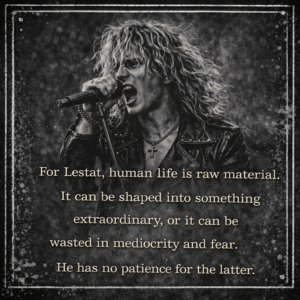
The Power of Idealism sees the world as it should be . And is perpetually, almost violently, aware of the gap between that vision and reality. For Lestat, human life (and immortal life) is raw material. It can be shaped into something extraordinary, or it can be wasted in mediocrity and fear. He has no patience for the latter.

This is why Louis , cautious, grief-stricken, endlessly questioning, drives Lestat to fury in both the novels and the AMC series. Louis keeps asking whether to live. Lestat has never once entertained the question. The answer is always yes. Always fully. Always now.

The AMC series deepens this tension beautifully. By setting the story in early twentieth-century New Orleans and making Louis a Black Creole man navigating a brutally stratified society, the show gives Louis’s hesitation real historical weight. It also sharpens Lestat’s incomprehension. To him, Louis has everything, beauty, intelligence, capacity for intensity, and still chooses suffering over transformation. For a Power of Idealism character, that is not just baffling. It is an affront.


Every Character Type carries a central story question — the deepest tension that drives them through a narrative.

For the Power of Idealism, that question is: Can I find — or create — a world worthy of my vision?

Lestat spends the entire Vampire Chronicles in pursuit of that answer. He makes vampires out of people he believes have the capacity for the life he envisions. He builds households, relationships, dynasties, not out of loneliness, but out of the Power of Idealism’s compulsive need to curate existence. To populate his world with people who can meet his standard.

When they can’t, or won’t, he is not just disappointed. He is affronted. Because to a Power of Idealism character, falling short of your potential isn’t a personal failure. It’s a moral one.

The AMC series makes this explicit in the dynamic between Lestat and Louis. Lestat’s cruelty isn’t random. It’s the cruelty of someone who believes absolutely in what Louis could become, and cannot forgive him for refusing to get there.


Lestat’s gift, and it is genuinely a gift, is that he makes others want more from their own lives. Louis, for all his resentment, is transformed by his centuries with Lestat. Claudia burns with an intensity she might never have found without him. Even the reader, even the viewer, watching Lestat move through the world with such unrepentant appetite, feels the pull of it.

This is the Power of Idealism at its best: the ability to raise the temperature of every room, every relationship, every moment. To make people believe that a more vivid, more fully inhabited life is actually possible.

Reid’s performance in the AMC series captures this quality in a way that’s rare onscreen. There are moments — Lestat at the piano, Lestat mid-argument, Lestat simply entering — where the character’s conviction is so total that you understand, viscerally, why Louis stayed as long as he did.


But the Power of Idealism has a Dark Side, and Anne Rice knew exactly where to find it.

A Power of Idealism character cannot accept limitation, not in themselves, and not in those they love. The vision of what should be is so absolute that it can become a kind of tyranny. Lestat doesn’t just want Louis to embrace immortality. He needs Louis to love it, the way Lestat loves it. When Louis refuses, Lestat experiences it as a fundamental incomprehensibility, a failure he cannot forgive, because he cannot understand it.

The Dark Side of the Power of Idealism is the inability to distinguish between their vision and reality. Between what they believe should be true and what is true. This is how a Power of Idealism character, at their most destructive, stops inspiring people and starts imprisoning them.

The AMC series is unflinching about this. The abuse at the center of Lestat and Louis’s relationship isn’t incidental, it is the logical extreme of a character whose love comes with conditions written in their own blood. Lestat’s vision of what their life together should be is so complete, so total, that Louis’s reality simply cannot fit inside it.

Claudia, in both Rice’s novels and the series, is the clearest expression of this. Lestat makes her a vampire because he sees in her the capacity for the magnificent, the intense, the fully alive. He cannot see, will not see, what it costs her. His vision is simply too complete to accommodate her reality.


Every Character Type has a lesson they must learn, or fail to learn, over the course of the story. For the Power of Idealism, that lesson is accepting the humanity — and the limitations — of others without abandoning the vision.

Lestat begins the Chronicles largely unable to do this. His love is real, but it demands too much. By the later novels, something has shifted, a hard-won acknowledgment that his vision of perfection cannot be imposed, only offered.

The AMC series is still writing that arc in real time. What makes it compelling is that the show refuses to let Lestat off the hook while also refusing to reduce him to a villain. He is a Power of Idealism character in full, capable of breathtaking tenderness and genuine destruction, often in the same scene.

That is the arc. And it resonates far beyond vampire fiction.


WHAT THIS MEANS FOR YOUR WRITING

Lestat endures, across Rice’s novels, the 1994 film, and now the AMC series, because his creators never confused his Character Type with his behavior. Lestat does outrageous things, selfish, manipulative, even monstrous things, but they always emerge from a coherent internal logic. He is never arbitrary. His worldview is legible on every page, in every scene.

That is the goal for any Power of Idealism character you write. The intensity, the refusal to compromise, the magnetic pull,  all of it must flow from that same unshakeable inner standard. Not from vanity. Not from ego. From an absolute conviction that life, lived fully, is worth everything it costs.

Lestat believes that with his whole being. And somehow, impossibly, he makes us believe it too.

Storytelling and the Persian New Year

In these very troubled times, we could all use a little hope and joy. The Persian New Year begins in Spring a time of rebirth and renewal.


Every year, as the last chill of winter loosens its grip, millions of people across Iran, Central Asia, the Caucasus, and diaspora communities worldwide pause to celebrate Nowruz — the Persian New Year marking the spring equinox. Rooted in Zoroastrian tradition and stretching back over three thousand years, Nowruz is far more than a calendar event. It is a living story, retold through ritual, gathering, and the quiet symbolism of a carefully arranged table. Before a single gift is exchanged or a single dish is served, Nowruz asks its celebrants to become storytellers.

At the heart of the holiday sits the haft-sin table — seven items beginning with the Persian letter “sin,” each one a chapter in a larger narrative about renewal and hope. The sprouts of sabzeh (wheat or lentil greens) speak of new beginnings; sib(apple) carries the ancient promise of health and beauty; somaq (sumac) foretells the sunrise after darkness. To set a haft-sin is to arrange a story about what it means to be human in a turning world. Elders pass down the significance of each item to children, grandchildren, and anyone willing to listen — so that the tradition itself becomes the vessel for cultural memory, crossing borders and generations without losing its meaning.

Nowruz has also inspired a rich body of storytelling in Persian literature. The great epic Shahnameh by the poet Ferdowsi — composed around 1000 CE — places the origin of Nowruz at the feet of the mythical king Jamshid, who is said to have ushered in a golden age of light and prosperity on the first day of spring. This story has been recited, illustrated, and performed for centuries, binding the holiday to the very idea of narrative itself. To celebrate Nowruz is, in some sense, to step inside a poem — to inhabit a story that insists the world can always begin again.

What makes Nowruz so enduring is exactly what makes all great storytelling endure: it holds something true. The spring equinox will come whether or not we mark it, but Nowruz transforms that astronomical fact into something felt — a shared exhale, a fire jumped over, a table set with seeds and mirrors, and the smell of something sweet cooking. In a fragmented modern world, the holiday reminds us that stories are not merely decoration. They are the architecture of belonging, the way communities hold themselves together across time. Nowruz is proof that the oldest stories, told faithfully enough, never really end. They endure.

Catherine Ravenscroft – Disclaimer

Catherine Ravenscroft – Disclaimer

Cate Blanchett’s Catherine Ravenscroft in Apple TV+’s Disclaimer offers a masterful study of what happens when the Power of Truth investigator becomes the investigated. Catherine is a celebrated documentary filmmaker who has built her career exposing the secrets and lies of powerful people. She’s the person who asks “What really happened?” and uncovers uncomfortable truths others want buried. But when a mysterious novel arrives, revealing her own devastating secret from decades past, Catherine must turn her investigative skills on herself as she tries to determine who’s exposing her and why.

The series creates exquisite Power of Truth tension through its structure: Catherine knows everyone has secrets (that’s her profession), but she believed her own secret was safely buried in the past. Now someone is weaponizing that secret against her, threatening to destroy her marriage, her relationship with her son, and her professional reputation. She must ask the classic questions—”Who’s exposing me? What do they know? How much will be revealed? Who can I trust?”—while confronting the horrifying possibility that the version of truth she’s been living with isn’t the only version, or even the correct one.

What makes Catherine particularly compelling as a Power of Truth character is the irony: the professional seeker of truth must confront uncomfortable truths about herself. She’s spent her career investigating others while maintaining careful control over her own narrative. Now that control is stripped away, and she experiences what her documentary subjects must have felt—the vulnerability of exposure, the fear that the truth will be misunderstood or weaponized, the desperate need to control the narrative before it destroys you. The show explores whether Catherine’s version of what happened years ago is the truth, a lie, or something more complicated—a self-protective story she’s told herself for so long that she’s lost track of what’s real. Her journey asks: Can a Power of Truth character investigate themselves honestly? Or does the need for self-protection inevitably distort the truth they claim to seek?

Charlie Cale – Poker Face

Charlie Cale – Poker Face

Charlie Cale, the itinerant casino worker-turned-amateur detective in Peacock’s Poker Face, may be one of the most literal Power of Truth characters ever created. Played with weary charm by Natasha Lyonne, Charlie possesses an almost supernatural ability that makes her the perfect investigator and the loneliest person alive: she can detect when anyone is lying to her. This gift—or curse—means she can never take anyone at face value, never fully trust a relationship, never believe comforting words, even when she desperately wants to.

Each episode finds Charlie drifting across America, in her 1969 Plymouth Barracuda, landing in a new town just in time to witness a murder. Unlike traditional detective shows, we see the crime committed in the opening minutes. The mystery isn’t whodunit—it’s whether Charlie can prove it, and more importantly, whether she can navigate a world where she knows everyone is lying to her. Her lie-detection ability gives her an investigative edge, but it also condemns her to perpetual isolation. How can you build a genuine connection when you’re always aware of the deception, however small, in every interaction?

What makes Charlie particularly compelling is how her superpower literalizes the Power of Truth worldview: things are never what they seem, everyone has hidden agendas, and trust is a luxury she cannot afford. She withdraws emotionally when she detects lies, investigating from a careful distance, but she also strategically embraces people—using her natural warmth and charm to get close enough to uncover their secrets. This tension between her need for human connection and her inability to trust creates the show’s emotional core. Charlie embodies the Power of Truth character’s fundamental paradox: she must move toward people to survive and solve mysteries, but her very gift ensures she can never truly be close to anyone. Unfortunately, the show is now cancelled.

Oz Cobb – The Penguin

Oz Cobb – The Penguin

Colin Farrell’s transformative performance as Oz Cobb in HBO’s The Penguin presents one of the darkest Power of Truth characters in recent memory. The series explores how a mid-level Gotham crime boss rises through the underworld by trusting absolutely no one, keeping secrets compulsively, and strategically building relationships he’s already planning to betray. Oz embodies the Power of Truth character who has fallen completely to the Dark Side—where paranoia isn’t a warning sign but a way of life, and where assuming everyone will betray you becomes a self-fulfilling prophecy.

Oz operates from a worldview of complete cynicism: everyone will betray you if given the chance, all relationships are transactional, and loyalty is just another commodity to be bought and sold. He constantly asks himself, “Who’s plotting against me? Who can I trust? How am I being played?” and his answer is always the same: trust no one. His immediate tactics are pure withdrawal—when threatened, he literally hides, retreating to plan his next move with paranoid vigilance. Yet strategically, he embraces others, building what appears to be loyalty and affection, only to use and discard people when they’re no longer useful.

What makes Oz particularly tragic is the Power of Truth irony at the heart of his story: his own mother, suffering from dementia, doesn’t recognize him. He is literally unknowable even to the person who gave him life. This creates a devastating metaphor for the Power of Truth character’s deepest fear—that even if someone wanted to love you, they couldn’t truly recognize or know you. Oz’s journey shows what happens when the Power of Truth character’s protective paranoia hardens into something monstrous. He proves his worldview correct by making it correct—he assumes everyone will betray him, so he betrays them first, ensuring that trust is indeed impossible and that he will die alone, powerful but unloved. The series doesn’t ask us to sympathize with Oz, but to understand how the Power of Truth character’s worst instincts, unchecked, create the very hell they fear.

Paul Atreides – Dune: Part Two

Paul Atreides – Dune: Part Two

Timothée Chalamet’s Paul Atreides in Dune: Part Two transforms the Power of Truth Character Type into mythic tragedy. Paul isn’t just investigating conspiracies—he’s investigating his own destiny through prescient visions that show him countless possible futures, most of them ending in betrayal, war, and catastrophe. This creates the ultimate Power of Truth nightmare: having access to the truth about what’s coming and still being unable to prevent it.

As Paul integrates into Fremen society, he must constantly ask, “Can I trust these visions? Who’s using me for their own purposes? Will Chani betray me when she discovers what I’m becoming? Can I trust myself not to become the tyrant I see in my possible futures?” His relationship with Chani (Zendaya) embodies the Power of Truth character’s impossible bind: he loves her, but he sees futures where his choices destroy that love. He wants to trust her, but he knows his transformation into the messianic Muad’Dib will drive them apart. He fears becoming the monster his visions show him, yet every step he takes to avoid that fate seems to move him closer to it.

Paul’s journey brilliantly illustrates the Power of Truth strategic contradiction. He must embrace the Fremen—earning their trust, becoming one of them, accepting their belief in him as their prophesied leader—while maintaining skeptical distance because he knows he’s being manipulated by forces beyond his control. The Bene Gesserit have planted the religious prophecy he’s fulfilling. His own prescience might be guiding him toward catastrophe. Even his love for Chani might be a weakness his enemies can exploit. By the film’s climax, Paul falls completely to the Power of Truth’s Dark Side: he becomes exactly what he feared; his paranoia is justified (everyone was using him); and his ability to see the truth only makes the betrayal more painful when it arrives. He drinks the Water of Life and sees all possible futures—the ultimate knowledge—and discovers that knowing everything makes choosing anything impossible. He embodies the Power of Truth paradox: searching for certainty in an uncertain universe only brings more uncertainty.

Lee Harker – Longlegs

Lee Harker – Longlegs

Maika Monroe’s FBI agent Lee Harker in the horror film Longlegs brings Power of Truth investigation into supernatural territory. Lee is hunting a serial killer who has somehow compelled seemingly normal families to murder each other, leaving cryptic coded messages at each crime scene. But as she investigates, Lee discovers disturbing connections to her own past and begins to suspect that her intuitive investigative abilities—her uncanny knack for being in the right place, for sensing things before they happen—might have a darker source than mere talent.

Lee operates from the classic Power of Truth worldview that hidden evil lurks beneath suburban normalcy. Every happy family might be harboring darkness. Every normal-seeming person might be concealing monstrosity. Her immediate tactics are pure withdrawal—she’s emotionally remote, investigates from careful distance, keeps people at arm’s length. But she must also strategically embrace the investigation, getting close to the killer’s pattern, putting herself in danger to uncover the truth. The film’s horror comes from the revelation that the conspiracy she’s investigating includes her own family—her mother made a deal with the killer decades ago that has shaped Lee’s entire life without her knowledge. This creates the Power of Truth nightmare: you can’t trust anyone, not even your own memories, not even your own mother, not even yourself. Lee must confront whether her entire identity as an investigator has been manipulated by the very evil she’s hunting.

Kate Wyler – The Diplomat 

KATE WYLER – The Diplomat

Keri Russell’s Kate Wyler in Netflix’s The Diplomat sets the Power of Truth Character Type into the highest levels of international politics. Every handshake conceals a hidden agenda, and every ally might be a hidden enemy. As the newly appointed U.S. Ambassador to the United Kingdom, Kate finds herself investigating a massive political conspiracy while simultaneously trying to figure out who she can trust in her own government—including, devastatingly, her own husband.

The series opens with Kate pulled from her posting in Afghanistan to navigate the political fallout from an attack on a British aircraft carrier. But as she investigates, she discovers layers of deception: who ordered the attack, who’s covering it up, and whether the conspiracy reaches into the highest levels of American and British government. Kate must ask the classic Power of Truth questions with lethal stakes: “What really happened? Who’s lying to me? Can I trust my own government? Is my husband involved in this conspiracy?”

What makes Kate a sophisticated Power of Truth character is how the role of a diplomat itself creates impossible contradictions. She must embrace others—building relationships, creating trust, maintaining diplomatic niceties—while maintaining the skeptical distance necessary to investigate the conspiracy surrounding her. She needs to appear confident and in control while privately drowning in uncertainty about who’s manipulating whom. Her marriage to fellow diplomat Hal (Rufus Sewell) adds another layer of Power of Truth tension: he’s both her closest advisor and potentially complicit in the conspiracy she’s investigating. Can she trust the person who shares her bed when everyone around them is lying?

By Season 2, Kate’s paranoia deepens as the conspiracy expands and she realizes she can trust fewer and fewer people. The show brilliantly captures the Power of Truth character’s strategic approach: Kate moves toward others to achieve her diplomatic goals, but she’s constantly stepping back– calculating, analyzing, looking for the betrayal she knows is coming. In a world of professional liars—diplomats, spies, politicians—Kate’s Power of Truth instincts aren’t neurotic; they’re essential for survival.

Ellie Williams: The Last Of Us – Power Of Truth Survivor

Ellie Williams from HBO’s The Last of Us is a character defined by her desperate need to know who she can trust in a world built on lies.

Born into a post-apocalyptic landscape where survival requires constant suspicion, Ellie is immune to the Cordyceps infection that has destroyed humanity. This makes her both precious and vulnerable: everyone wants something from her, but she can never be certain of their true motives.

Her defining fear—that everyone she cares about will either die or leave her—drives every relationship and ultimately shapes both her redemption and her destruction.

Ellie’s worldview is shaped by abandonment and betrayal at every turn. Her mother died at her birth, she was raised in a FEDRA orphanage, her best friend Riley left to join the Fireflies (then returned only to die), and every adult figure has either abandoned her or revealed hidden agendas.

Like all Power of Truth characters, Ellie believes “things are never what they seem” and “everyone has secrets.” In her world, this paranoia isn’t neurotic—it’s survival.

FEDRA claims to protect while actually oppressing. The Fireflies present themselves as humanity’s saviors while planning to kill her to synthesize and harness her immunity. Even love comes with lies, as she discovers when Joel—the person she finally learns to trust—betrays that trust with a devastating deception. He lies about what really happened at the hospital, where she was promised her immunity could provide a cure for the deadly Cordyceps infection.

Her relationship with Joel forms the emotional center of her Power of Truth journey. She constantly tests him: “You’re not going to leave me, right?”

The classic Power of Truth question—”Who can I trust?”—dominates their dynamic. She slowly, painfully learns to trust Joel completely, telling him, “Everyone I have cared for has either died or left me. Everyone—fucking except for you!”

This makes Joel’s lie about the Fireflies the ultimate Power of Truth nightmare: the person she trusted most took away her choice and lied to her face about it. When she asks him to “Swear to me that everything you said about the Fireflies is true,” and he says “I swear,” he doesn’t just betray her—he makes her doubt her own instincts.

For a Power of Truth character, being right about sensing deception but being gaslit into questioning yourself is the deepest wound possible.

In later episodes, Ellie falls completely into the Power of Truth Dark Side. After Joel’s murder, she becomes consumed by paranoia, trusts no one (not even her lover, Dina), and loses track of reality through PTSD flashbacks. She pursues revenge with such single-minded obsession that she destroys everything Joel died protecting—her future, her family, her peace.

Power of Truth characters in their darkest moments become “paranoid, delusional, basket cases”—and Ellie embodies all of this. She looks for evidence to confirm her rage, tests everyone’s loyalty until they break, and reads sinister meanings into everything. Her quest for certainty about who killed Joel and why becomes a death spiral that costs her Dina, her ability to play guitar (her last connection to Joel), and nearly her humanity.

Yet Ellie’s final choice—releasing Abby instead of drowning her—suggests she may be learning the hardest Power of Truth lesson: that “maybe is a very slim reed to hang your whole life on, but that’s the best we have.”

She acts on instinct (the Joel flashback) rather than paranoid calculation. She chooses mercy without certainty that it’s right. She accepts she’ll never know whether Joel’s choice was justified, whether the vaccine would have worked, or whether her life has the grand meaning she sought.

The Last of Us presents the Power of Truth character’s ultimate test: Can you survive when everyone really is lying, when the conspiracy is real, when trust inevitably leads to betrayal?

Ellie’s answer—traumatic, costly, but ultimately hopeful—is that you can choose connection over certainty, mercy over answers, and peace over the endless, destructive quest for absolute truth.


About the Nine Character Types®: The Power of Truth is one of the Nine Character Types explored in my book series. These characters are investigators, secret-keepers, spies, and skeptics, driven by the need to uncover what’s hidden—and haunted by the fear that, eventually, everyone will betray them (or they will betray themselves). ORDER eBOOK HERE

Mad Men – Emmy Winner

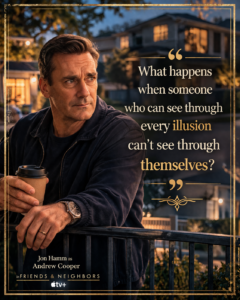
Mad Men won 2010 Emmy Awards for Outstanding Drama Series and Outstanding Writing in a Drama Series. The show is about the world of advertising; a world of illusion, sleight of hand and outright deception. It is a quintessential Power of Truth story and is anchored by a wonderful Power of Truth protagonist, Don Draper/Dick Whitman (Jon Hamm).

Continue reading

Change: Power vs Influence

“Strong men do not need power. The weak are destroyed by it.” This quote is from the film Nicholas and Alexandria, directed by Franklin J. Schaffner, from a screenplay by James Goldman and Edward Bond, based on Robert K. Massie’s book.

Only a handful of people possess real power. Howard Suber, my great mentor at the UCLA Film School, defined power as the ability to produce change or the ability to prevent change. 
Change through power is achieved through force of personality, personal will, or physical force. This power is derived from authority or control. It is status-driven. 
Contrary to power, which is often associated with high status, an alternative force is accessible to everyone, even those of low personal status. This force is the power of influence. Influence, which can be more significant than power based on position or control, is a democratic force that draws no attention to itself and keeps one out of the line of fire, making it a potent tool for effecting change.
 
Power can be yielded through authority, like that derived from heads of state, government officials, kings, teachers, and parents who hold enough control over others to enforce their dictates. On the other hand, a low-status artist or a writer might have enough influence to inspire a change of perspective and alter the course of another’s life.

Power compels people to change their course, but influence illuminates the reasons behind the change. Power is often associated with wealth, position, or status. However, the right words and actions can reshape history even by low-status individuals. A prime example is Gandhi, who lacked authority and high status, yet his influence was profound enough to alter the course of Indian history and expel the British from India.

Trust is the crucial distinction between power and influence. Power, often driven by fear, can coerce change. In contrast, influence is a visionary, persuasive, and voluntary force rooted in trust and integrity. It inspires people to respond positively and enthusiastically to the proposed changes, underscoring the ethical dimension of influence and its potential to inspire action. 

True leaders do not seek leadership as a position of authority but strive to earn influence. This influence is not bestowed or seized but gained through the trust and respect of those they inspire to embrace change. Trump has power. Obama had influence.

Make your character an agent of change. Show how they inspire trust and what they do to illuminate the need for change. Trust is gained by action more than by words. “Watch what people do, not what they say.”
 

The Power of Imagination

Todd Chavez


BoJack Horseman

Tod Chavez of BoJack Horseman, the Netflix animated series, is a great example of a Power of Imagination Character. Power of Imagination Characters are gentle, accommodating, and hate direct confrontation.


Naïve and Childlike


We meet Todd Chavez as an easygoing slacker who sleeps (and lives) on BoJack’s couch. While Todd may seem lost in everyday life because of his consistent and quite stunning lack of focus, his unfeigned optimism can be very inspiring: “As my blood type always says… B positive.”

Todd is a lazy dreamer and likes to go with the flow. Nevertheless, he comes up with crazy ideas almost daily. Although these ideas are rarely thought through from beginning to end, Todd believes in them with the conviction of a child. “I never know if I can handle anything”, he says at one point with genuine delight. “That’s what makes my life so exciting.”

Believing the Best

Todd’s naivety and innocence serve as a contrast to lead character BoJack’s self destructive behavior. Actions that often harm the people around him. In fact, Todd is one of the people that BoJack repeatedly hurts. At the start of the series, Todd wants to have a friendship with BoJack who he genuinely believes to “secretly have a good heart.”
He naturally sees the good in people and believes that they can improve.

Season 1 sees the first big crack in their relationship when BoJack sabotages Todd’s rock opera for selfish reasons. At first, Todd who naturally likes to restore peace resorts to passive-aggressive behavior instead of confronting BoJack. Later in the series, Todd learns his lesson and stands up for himself, resulting in cutting BoJack out of his life. He finally realizes how much of a toxic influence BoJack is on him. When Todd learns that BoJack slept with the girl he likes in season 3, he finally confronts him: “You can’t keep doing shitty things and then feel bad about yourself like that makes it okay. You need to be better.

Finding Himself

In later seasons, Todd’s and BoJack’s relationship is restored to some extent although it never gets back to how it was. Todd learns to follow his own path instead of going along with everyone else’s. In season 4’s “Hooray! Todd Episode!”, Todd spends a whole episode trying to fix the problems of his friends who simply expect him to have nothing else to do.
While he masterfully performs multiple tasks at once in his own chaotic but highly creative way, nobody even recognizes his efforts.

In a way, this is his curse: While Todd stumbles through life with the unwavering need to keep the people around him happy, he himself is constantly being overlooked and undervalued by these very people. Fittingly, he says in this episode: “I do love getting my picture taken. It’s proof I exist.” Todd becomes increasingly aware of this, stating only a few episodes later: “It’s always nice to be included in a sentence someone says.”

At the end of “Hooray! Todd Episode!”, however, it’s BoJack who surprisingly acknowledges how much Todd does for everybody. After BoJack tells Todd how much he appreciates him, Todd finally finds the courage to do what’s best for himself instead of doing what’s best for others. Having recently realized that he is asexual, he takes the first step to embracing it and goes to an asexual meet-up. Todd comes to terms with his childhood, reconnects with his family and even finds love.

In the last season, his stepdad Jorge tells Todd that he had always been mean to him because the world is mean. Todd replies: “Not my world.” While asserting himself, Todd chooses to hold on to his optimism and never loses his intuitive ability to anticipate what his friends need. In the last episode, Todd drags BoJack out of a party to watch fireworks with him on the beach. But while Todd uses his childlike exterior to convince BoJack to come with him, he doesn’t do it for himself. “So, why did we need to be on the beach?”, BoJack asks. “Oh”, Todd replies. “You just seemed really overwhelmed at the party.”

The Power Of Love Character

Get your Valentine’s Day cards out, bring on the chocolate hearts, and strew rose petals where you may—It’s February! It’s fitting that we take a look at the Power of Love character in this month’s newsletter. Thanks for sticking with me as I revive my monthly mailbox musings.

What is a Power of Love character?

I’m using those words as a “term of art.” A term of art is a word or phrase with a precise meaning in a particular subject area. In the Emotional Toolbox Approach, the Power of Love is the name of a combination of emotional forces that drives a particular Character Type through a story.

I’m gonna make you love me

Power of Love characters believe that if they make themselves indispensable and/or irresistible, the other person will need them and be obliged to love them. Love is a mutual obligation. This might be stated: “I’ve done everything for you. I sacrificed and slaved for you. I made you who you are. You owe me.” Or, in the case of a spouse or lover: “I gave you the best years of my life. You owe me.”

An iron fist in a velvet glove

On a paper valentine, it says simply and powerfully, “Be Mine.” Possessiveness and passive/aggressive domination can be a toxic hallmark of these characters. These Dark Side Power of Love characters want to control, prevail, gain dominance, or conquer another’s heart.
They see their own value reflected in the eyes of their love object. Their philosophy might be stated: “You’re nothing without me. (And I feel I am nothing without you.)”

Who are these people?

A character driven by the Power of Love is often a long-suffering best friend, a great mentor, an over-zealous parent, a beleaguered assistant, or someone who tirelessly pushes another forward in a story. At their worst, these characters are stalkers, jealous lovers, crushingly caring parents, needy spouses, clingy co-dependents, or self-pitying martyrs for love.
Let’s look at both sides of this Character Type in the Netflix series You and the Apple + series Ted Lasso.

You


The first season of You is a Netflix series that veers from a millennial meet-cute Rom-Com to a creepy cyber security stalker tale. The show is based on Caroline Kepnes’ novel.

Aspiring writer Guinevere Beck (Elizabeth Lail) meets mild- mannered bookstore manager Joe Goldberg (Penn Badgley). Joe falls head-over-heels in love but struggles to escape the “Friend Zone.”

Joe weasels his way into Beck’s private life. Her social network settings are sloppy and easily opened. He follows her nights out, learns her plans, discovers her yearnings, and knows her insecurities around her rich girlfriends. He is especially interested in their snarky comments made about him.

Joe pursues a careful, steady courtship of Beck. He earns her trust and encourages her talent. Her snooty friends don’t stand a chance in the face of his charm offensive and sly skullduggery. Joe stops at nothing to remove the obstacles that keep Beck from loving him.

Love me or else

Joe is a toxic Power of Love character. He lavishes his attention and affection on Beck to exercise control, prevail, gain dominance, and conquer her heart. These characters see their value reflected in their love object’s eyes. Their philosophy might be stated: “You’re nothing without me. (And I feel I am nothing without you.)”

Joe is a compelling Power of Love male lead. He is soft, gentle, and compliant on the outside—but made of strong, even steely, stuff on the inside, with a heavy added dose of the dangerous psychopath.

Ted Lasso


The Apple TV+ series Ted Lasso evolved from a group of spots NBC Sports ran to promote English football (soccer). The title character, Ted Lasso (Jason Sudeikis), is an American college football coach from Kansas who—inexplicably— is hired to manage a Premier League team in London. The antagonistic squad hates his energetic “go team” American bullshit, and fans chant “wanker” at him everywhere he goes.


Ted arrives in London with boundless optimism but fully understanding that, technically, he is completely unqualified to coach the last-place AFC Richmond football team. In true Power of Love fashion, coaching isn’t about brilliant strategy, understanding all the arcane rules of the game, or the history of the most famous players; it’s about helping his players “be the best versions of themselves on and off the field.”

He’s aided in this mission by his best friend, Coach Beard (Brendan Hunt), and slyly sabotaged by Richmond’s new owner, Rebecca (Hannah Waddingham). She inherited the team in a bitter divorce and hires Ted to get back at her nasty, philandering ex-husband (Anthony Head) by destroying his beloved team.

No one expects Ted’s kindness and persistence to elevate everyone in the team’s orbit. Ted leads by pushing others forward and putting the team first. His compassion, humility, enlightened discipline, and common decency change everyone around him.

He is the most positive version of the Power of Love leader. He is a true mentor, a man sensitive to those around him, who empowers everyone in his purview. He always has the good of the team at heart and teaches his players to be as selfless and dedicated as he is.


Get your Valentine’s Day cards out, bring on the chocolate hearts, and strew rose petals where you may—It’s February! It’s fitting that we take a look at the Power of Love character in this month’s newsletter. Thanks for sticking with me as I revive my monthly mailbox musings.

What is a Power of Love character?

I’m using those words as a “term of art.” A term of art is a word or phrase with a precise meaning in a particular subject area. In the Emotional Toolbox Approach, the Power of Love is the name of a combination of emotional forces that drives a particular Character Type through a story.

I’m gonna make you love me

Power of Love characters believe that if they make themselves indispensable and/or irresistible, the other person will need them and be obliged to love them. Love is a mutual obligation. This might be stated: “I’ve done everything for you. I sacrificed and slaved for you. I made you who you are. You owe me.” Or, in the case of a spouse or lover: “I gave you the best years of my life. You owe me.”

An iron fist in a velvet glove

On a paper valentine, it says simply and powerfully, “Be Mine.” Possessiveness and passive/aggressive domination can be a toxic hallmark of these characters. These Dark Side Power of Love characters want to control, prevail, gain dominance, or conquer another’s heart.
They see their own value reflected in the eyes of their love object. Their philosophy might be stated: “You’re nothing without me. (And I feel I am nothing without you.)”

Who are these people?

A character driven by the Power of Love is often a long-suffering best friend, a great mentor, an over-zealous parent, a beleaguered assistant, or someone who tirelessly pushes another forward in a story. At their worst, these characters are stalkers, jealous lovers, crushingly caring parents, needy spouses, clingy co-dependents, or self-pitying martyrs for love.
Let’s look at both sides of this Character Type in the Netflix series You and the Apple + series Ted Lasso.

You


The first season of You is a Netflix series that veers from a millennial meet-cute Rom-Com to a creepy cyber security stalker tale. The show is based on Caroline Kepnes’ novel.

Aspiring writer Guinevere Beck (Elizabeth Lail) meets mild- mannered bookstore manager Joe Goldberg (Penn Badgley). Joe falls head-over-heels in love but struggles to escape the “Friend Zone.”

Joe weasels his way into Beck’s private life. Her social network settings are sloppy and easily opened. He follows her nights out, learns her plans, discovers her yearnings, and knows her insecurities around her rich girlfriends. He is especially interested in their snarky comments made about him.

Joe pursues a careful, steady courtship of Beck. He earns her trust and encourages her talent. Her snooty friends don’t stand a chance in the face of his charm offensive and sly skullduggery. Joe stops at nothing to remove the obstacles that keep Beck from loving him.

Love me or else

Joe is a toxic Power of Love character. He lavishes his attention and affection on Beck to exercise control, prevail, gain dominance, and conquer her heart. These characters see their value reflected in their love object’s eyes. Their philosophy might be stated: “You’re nothing without me. (And I feel I am nothing without you.)”

Joe is a compelling Power of Love male lead. He is soft, gentle, and compliant on the outside—but made of strong, even steely, stuff on the inside, with a heavy added dose of the dangerous psychopath.

Ted Lasso


The Apple TV+ series Ted Lasso evolved from a group of spots NBC Sports ran to promote English football (soccer). The title character, Ted Lasso (Jason Sudeikis), is an American college football coach from Kansas who—inexplicably— is hired to manage a Premier League team in London. The antagonistic squad hates his energetic “go team” American bullshit, and fans chant “wanker” at him everywhere he goes.


Ted arrives in London with boundless optimism but fully understanding that, technically, he is completely unqualified to coach the last-place AFC Richmond football team. In true Power of Love fashion, coaching isn’t about brilliant strategy, understanding all the arcane rules of the game, or the history of the most famous players; it’s about helping his players “be the best versions of themselves on and off the field.”

He’s aided in this mission by his best friend, Coach Beard (Brendan Hunt), and slyly sabotaged by Richmond’s new owner, Rebecca (Hannah Waddingham). She inherited the team in a bitter divorce and hires Ted to get back at her nasty, philandering ex-husband (Anthony Head) by destroying his beloved team.

No one expects Ted’s kindness and persistence to elevate everyone in the team’s orbit. Ted leads by pushing others forward and putting the team first. His compassion, humility, enlightened discipline, and common decency change everyone around him.

He is the most positive version of the Power of Love leader. He is a true mentor, a man sensitive to those around him, who empowers everyone in his purview. He always has the good of the team at heart and teaches his players to be as selfless and dedicated as he is.


Just Do It!

Did your New Year’s resolutions include finishing that passion project? Any writing project is daunting. Going from the first blank page to 100 screenplay pages or 300 novel pages is a huge challenge. But the answer to “How do you eat an elephant?” is, one bite at a time. The way to accomplish any goal is incremental progress. Get started and keep going.

Robert Collier, one of the first self-help authors, said: “Success is the sum of small efforts, repeated day in and day out.”

Be consistent. Be diligent
Get started. Keep going

When I was a student in the UCLA Master’s in Screenwriting program (oh so many years ago) we had 10 weeks to go from blank page to finished first draft. The way I could meet that deadline time after time was to write 5 pages a day. Just 5 pages. Everyday. I never had to pull all-nighters or hand in an unfinished draft. I was a full-time student then. Five pages may be too much for someone working full time.


So here is a workable alternative:

  1. Have a bite sized manageable writing schedule
    Set a modest daily goal — set aside one hour a day to write
  2. Leave yourself a starting place
    When you hit your one hour goal, stop. Stop even if you’re in the middle of a bit of dialogue. Especially if you’re in the middle of character back and forth. That way, when you sit down the next day, you have a jumping off place to give you a push.
  3. Press on with the real job
    Research isn’t writing. When you come to a factual or an information gap, don’t Google it and fall down the inevitable rabbit hole. When you have finished that first draft, type “QC” where the missing bit should go, as in “The Sonora Desert, all QC miles of it, stretched before him”. A quick search through your document for “QC” will tell you what fact-checking to do or missing information to fill in.
  4. Head down and butt in chair
    Forget advice about finding the right atmosphere to inspire you … You can put up with noise/silence/kids/discomfort/hunger for one hour. (For those 60 minutes all you do is write and don’t allow ANY distractions in) Set a timer and point to it if someone wants to interrupt you.
  5. Get help to realize your goal
    I believe so deeply in this approach I wrote an online course that helps writers finish a first draft writing just one hour a day. I started with the presumption that most people using the course had busy work lives, active families, and ongoing social obligations.
 

But everyone, no matter how busy, can block out one hour a day.

The course is a step-by-step guide. You have a specific assignment each day. There is screenwriting information, video lessons, and all the material you need each day.

To learn more about The One Hour Screenwriter eCourse click HERE


THE VISUAL WORLD – PART THREE


PART THREE

 
THE WORLD OF THE RIVER

Rivers are roads in or roads out. They are places of passage and symbolize a
journey. One never knows what is behind the next bend. It could be calm,
clear waters or churning, treacherous rapids. Friends and foes appear
unexpectedly along the way. Sometimes it’s hard to know which is which.

DELIVERANCE and THE RIVER WILD both depict the dangers of a river
journey.

Navigating the river requires hard work, but also allows time for floating
free. The river world is a place of rhythm and flow. The object here is the
journey rather than the destination.

THE WORLD OF HOUSE AND HOME

House and home is the first world we know as children. Home is the center
of our universe. It is the central space of human drama. Everything we
know about love we learn here first. Everything we know about conflict and
violence, we first discover here.

There are two kinds of houses—warm and cold. A warm house is a place
of happy memories. It is a nostalgic place, a place where we are accepted
and loved. A warm house is bright and happy. The glowing kitchen is the
heart of this kind of home. It is open and friendly.

The cold house is often a trap or prison. It can be a place of cruelty and of horror.
This is a house where terrible secrets are kept and/or where its inhabitants are
hunted or haunted. The cold house is dark and dreary. It is a closed and often
claustrophobic place.

Inside the house, certain spaces have deeper meanings and symbolic
significance.

The attic is a place of the past. It is a place where valuables and unexpected
treasure is hidden. The attic is a repository of memories and old keepsakes.
It can also be a place where we leave our past behind and struggle toward
the future. Artists and writers often create in attic or garret spaces. The attic
is a place of make-believe and imagination. It can also be a place of
madness—where family secrets are hidden or locked away.

The cellar is a place where things are buried. Cellars are dark, dank, scary
places. They are often where monsters lurk. A cellar is often a place of
ugly secrets, torture, and/or darkness.

THE HAUNTING OF HILL HOUSE is the ultimate cold house horror movie.
THE FABLEMANS is a warm house movie filled with love and eccentricity, but
no small amount of tension and conflict.

COMBINED WORLDS

The most powerful worlds can be combinations. For example, the city can
be depicted as a jungle—a place of rot and decay where men hunt and kill
each other. Or it can be depicted as the ocean surface—the rooftops maybe
placid but below lurk all kinds of conflict, turmoil, and danger waiting to trap
or devour us.

The city can be viewed as an island, as Manhattan physically is.
The island/city is a place both magical and nightmarish. Cities can be
depicted as a mountain world. A city might be a vertical place of majestic
heights where the mighty look down on the lowly. This is a place where
the rich tower above the poverty and oppression below. The city
might also be a small dot on the open plains where civilization is purchased
at the expense of freedom and wide-open spaces.

THE WORLD OF THE FOUR SEASONS

Summer is a time of equilibrium. It is a time of utopia—it is always summer
in Camelot. Summer is a lush time. It is a time of beauty and golden
sunlight. Summertime is when “the living is easy.”

Autumn is a time of harvest—when crops are gathered into the barn as stores
against the coming of winter. It is a time of waning days and fading
sunlight. Autumn often is the time when the hero falls. It is when opponents
often attack. Autumn usually signals the end of things—when the best days
are behind us, and only bleakness lies ahead.

Winter is the lowest time of the year. In winter, the hero is closest to death.
Winter is an arid, frozen time. All hope is lost. The world seems dark, and
everything hovers on the edge of extinction.

Spring is the time when hope is reborn. In spring, we shed our skin and begin
life anew. A new equilibrium is achieved. A new order is restored. The hero
rises again or is reborn at some higher level. Spring is the time of
resurrection and the renewal of all things.

Anti-seasonal structures can often be used to create dynamic opposites by
contrasting traditional cycles with the dramatic developments in the story.

For example, marriage in winter (what does this mean—are the darkest
days behind us?) Perhaps the hero falls at the height of summer (is he
destroyed at the height of his powers and waiting to be reborn when he can
turn his greatest weakness into his greatest strength?) Playing against
seasonal cycles offers a rich and potent way to depict the emotional
undercurrents in the story.

Use the visual world to deepen and enhance your story and shorthand its
underlying themes. Cue the audience as to how your protagonist “sees” his/her
world and himself/herself, and use the visual world to express the protagonist’s
emotional state. The visual world should be as unique as the protagonist
him/herself.

THE VISUAL WORLD – PART TWO


PART TWO

 
THE DESERT WORLD

The desert is a world of stark beauty and contradiction. It is a place of death
and dying and a place of revelation and inspiration. It offers cool oasis and
cruel mirage. Characters find personal growth here through isolation. The
desert world is a place of personal testing and inner contemplation. It is
where visions appear. But can they be trusted? The desert is also a place of
shifting sands—where men can easily lose their way and wander in circles.
The desert is a place of temptation. Souls can be won or lost here.

LAWRENCE OF ARABIA is the granddaddy of sweeping desert epics. DUNE is
a more recent example.

THE WORLD OF ICE

The frozen world is a physical mirror image of the desert world. Characters
are hardened by experience and trial here. It is a place where only the strong
survive. It is not necessarily a place characters go alone to be tested. Survival
here often depends upon the help of others. This is a place where there is no
warmth except that within the human heart.

Cooperation is the key to survival in the frigid world of THE DAY AFTER
TOMORROW. The same is the case in George Clooney’s MIDNIGHT SKY.

THE OCEAN SURFACE

The surface of the ocean is an uncharted wasteland, like a desert and the frozen
world of ice. The object on the ocean surface is to get across. Hidden
danger lurks just below. One could be swallowed up at any time or attacked
without warning.

This is a place surrounded by water where the greatest danger is often the
lack of what is so abundant. Water that is usable is the ocean’s scarcest
commodity. It is a place where one tests oneself against nature-where one
feels very small and yet flings oneself against the might of God.

THE LIFE OF PI is a great example. As is THE PERFECT STORM.

THE ISLAND WORLD

An island is an isolated plot of land with a clear boundary. It is surround by
an often uncharted sea. There are unlimited possibilities here. An island can
be heaven or hell, paradise or death sentence, a place of magical beauty or
terrible nightmare. Both wonderful creatures and terrible monsters can
inhabit an island.

The island world is a place of mystery. One can enter a different reality
here. An island is a natural place and an abstraction. A person can find
him/herself alone on an island, even in the middle of a crowd—an island can
be a state of mind.

In CAST AWAY, Tom Hanks survives loneliness and isolation. JURASSIC
PARK is a zoo of monsters.

THE MOUNTAIN WORLD

The mountain world is a place of awesome height and majesty. It often is a
place of revelation and inspiration. One goes to the mountain to seek
answers. The mountain world requires great courage and physical strength.

TOUCHING THE VOID is about hard choices and moral questions in the
mountain world.

A mountain is a vertical world—a place of hierarchy and privileged position.
On the mountaintop, one can look down on those below. It is a citadel of
strength. The mountain world can be a stronghold to keep others out.
Tyranny and oppression are possible from on high. Kings live on
mountaintops so do gods and monsters.

In THE LORD OF THE RINGS trilogy, Sauron lives on the mountaintop in his
quest to subjugate all of Middle Earth.

THE WORLD OF THE PLAINS

The world of the prairie and the plains is very American. It is a place of
open vistas and clear views. You can see someone coming from miles away.
This is a place of freedom and unlimited opportunity.

Everyone can be equal here. Anyone can make a claim here and put down
roots. This is a place where people work hard to subdue nature. Towns can
be built and civilization established. The land can be tamed by the plow.

This is also a place of conflict. How will the land be divided? Who wants
fences, and who wants free open spaces? The plains are a fertile area for the
clash between the price of progress and the price of freedom.

DANCES WITH WOLVES and the more recent KILLERS OF THE FLOWER
MOON are both about battles with indigenous people over land and resources.

To be continued in PART 3

THE VISUAL WORLD – PART ONE

PART ONE

This is a three (3) part series exploring the visual world of a film.

The visual world of a film is not just the place the protagonist happens to be.
It is a physical metaphor for the arc of the protagonist’s character.

The visual world cues the audience as to how your protagonist “sees” his/her world
and himself/herself. It conveys the protagonist’s emotional state. It
should be as unique as the protagonist him/herself. The visual world should
develop and become more detailed as we learn more about the protagonist
and as his/her character develops.

SETTING AS A CHARACTER ARC

Even a film set in a familiar city can do this. For example, The New York
City of MANHATTAN or YOU’VE GOT MAIL is very different from the
New York City of TAXI DRIVER or MIDNIGHT COWBOY. More
recently the New York of IN THE HEIGHTS couldn’t be more different than A
QUIET PLACE: DAY ONE.

The best films condense the visual world of the film to as small an area as
possible. These films construct a single unified space surrounded by some
kind of hypothetical “wall” that separates the action from everything else.

This area must be large enough for diversity and conflict but contained
enough to heighten and concentrate the action. Good games require
manageable, clearly defined playing fields.

There is also rich symbolic value inherent in different types of visual worlds.
Used wisely, this symbolism will heighten and deepen the richness of a
story.

THE OCEAN WORLD

Water is the most powerful medium of suspension. The ocean world is a
weightless world. Time moves at a different pace here. Light is dim and
liquid. It is a dreamlike place. The ocean depths are places of our deepest
fears. This world contains hidden dangers and sunken treasure. Bizarre or
prehistoric creatures still roam free. It is a place of the past—ancient
Atlantis, old shipwrecks and sunken civilizations lie hidden on the ocean
floor.

Both JAWS and OPEN WATER certainly use the implacable terror of the deep to
great effect.

THE WORLD OF OUTER SPACE

Outer space is a world of the imagination. It is a place of unlimited
diversity—any kind of terrain and any kind of creature can exist here. This
is a world of infinite adventure. The physical rules of our world don’t apply.
Time/space logic is altered here. Outer space can be a place of the future or
a place of the past. It can be a place of potential utopia or hellish
oppression.

2001: A SPACE ODYSSEY is the great granddaddy of modern interstellar movies.
GUARDIANS OF THE GALAXY takes a more psychedelic view of space.

THE JUNGLE WORLD

The jungle is a place of rot and riot. Here, the dead decompose as nature
runs rampant over the fallen corpses. Order breaks down here, and chaos
eats away at the civilized world. Man can never tame the jungle. Here,
chaos is always more powerful than control.

The jungle is a place of disease, delirium, and madness. It’s a world where
animals devour other animals and where the most civilized men can be reduced
to beasts. The natural order is kill or be killed.

APOCALYPSE NOW best exemplifies the horror, rot, and chaos of the jungle as a
metaphor for the War in Vietnam.

It’s impossible to gain perspective here. Things are too tangled and
twisted—logic is obscured and choked like trees overrun by vines. In the
jungle world, we can only see a short way ahead. Death and destruction
lurk, unseen, right in front of us. It is a place of unexpected terror and
invisible enemies.

THE FOREST WORLD

The Forest is a wild place, but it is tamer than the jungle. This is a place
where people get lost and can’t find their way. It is a dark place. Danger is
everywhere. Wild beasts wait in the shadows with red eyes and bared fangs.

Ghosts live here, and haunting often occurs in the forest world. The forest is
a place of the past. It is the world of ancient fairytales. Fear comes from the
mind of the person lost there, as often from any actual danger encountered.

INTO THE WOODS is a great example of the enchanted forest. BLAIR WITCH
PROJECT chillingly expresses the horror and myth of the woods.

To be continued in PART 2

Logan Roy – Power of Will

Logan Roy

Succession

Power of Will characters believe that expanding their power base,
extending their territory, protecting and defending what is rightfully
theirs (according to them) and swiftly avenging any wrong (or perceived
wrong) is how one gets along, gets ahead, and stays ahead in the world.

Power of Will characters take what they want, fight for every inch of
turf, refuse to show any weakness, and pounce decisively on the
weakness of others. They have a kill-or-be-killed framework for
everything. They believe absolutely in the Law of the Jungle.

In the series, Logan Roy is the CEO of Waystar Royco, a huge media
conglomerate, and rules it with an iron fist. Everyone looks up to him –
a born leader and always the focal point of every room he’s in. To
Logan, business is a fight, and he must annihilate his opponents. He
manipulates and bullies people and strikes deals without thinking about
morals for a second. Everything he does serves to expand his power –
it’s all about winning. “Life is not knights on horseback.” “It’s a number
on a piece of paper. It’s a fight for a knife in the mud.”

Logan only values others if they help him achieve a desired goal. This
includes his own children. Logan shows no hesitation in blackmailing his
son or using him as a scapegoat to save the company. He coerces all his
kids, Kendall, Siobhan, and Roman, to compete against each other to
become the heir to his throne. Having built his empire from scratch, he
thinks being hard on them teaches the cutthroat nature of business.

But too often, Logan’s disappointment with his kids’ entitlement and
incompetence leads to him insulting and degrading them. “I love you”,
he tells them. “But you are not serious people.”

It’s a twisted father-child relationship where love doesn’t seem to have
a place. Logan looks at everything from a business/power perspective.
Feelings like love or affection are perceived as weakness. When he tries
apologizing to his kids in Season 4 after the three of them go against
him, it might come from a sincere place – but Logan’s main objective is
to get his kids on board for a business decision.

“There is nothing you could say to me now that I would ever believe”,
Shiv tells him, grappling with the fact that her father’s reputation alone
seems to have the power to bend reality. “[…] You don’t fucking know
everything! Just ‘cause you say it, doesn’t make it true. Everyone just
fucking agrees with you and believes you, so it becomes true and then
you can turn around and say like, ‘Oh, you see? See? I was right.’ But
that is not how it is. You’re a human fucking gaslight!”

After suffering a stroke in the first episode of the show, Logan
confronts his own mortality. But he doesn’t accept his increasing
vulnerability and runs the company, always focusing on the future.
“The future is real”, he tells Shiv. “But the past, well, it’s all made up.”

Throughout the show, we get hints of the past Logan doesn’t like to talk
about. We can see scars on his back from the beatings his abusive
Uncle Noah gave him, and we learn that Logan blames himself for the
death of his sister Rose, who died from Polio. But Logan doesn’t talk
about any of it – because talking about it would make it real and make
him seem weak.

Similarly, Logan never apologizes or even acknowledges his abusive
behavior towards his kids and grandkids. After hitting Roman in the
face after an outburst of rage, he plays it down. “I didn’t even know you
were there”, he tells Roman. “[…] Did I even make contact? […] Because
that’s not something I do, you know.” Only – it is exactly what he does.
Logan Roy bends reality to make his narrative become the truth.

As almighty as he seems during his lifetime, Logan Roy proves to be
human in the end. He dies without a great bang or warning, mostly off-
screen on the way to seal a business deal that would hand the company
over to the tech billionaire Matsson instead of one of his own children.

And on the day of his oldest son Connor’s wedding, Logan doesn’t
attend, prioritizing business over family one last time. But even with
Logan’s death, his presence is still felt in the show’s final episodes. Like
a shadow, he haunts his children, who struggle to accept that they will
never be equal to their father. Ultimately, the business deal Logan
planned goes through, and Matsson takes over the company. Even
from the grave, Logan still wins.

Pen, Paper, and Personalities

The Jack Benny Show

The Jack Benny Show “The Jack Benny Show,” written by long-time Benny writer, heck, long-time radio and television writer, Milt Josefsberg. (Google Milt for his wonderful history) is a wonderful read.

Here’s what Milt has to say about writers (in 1977, but still true today). He is discussing the writers Jack has employed over the years, but it applies far more broadly (you know Milt is talking about YOU!).

Quoting from Chapter 13:

Writers come in all ages, religions, creeds, sexes, intermediate sexes, sizes, and temperaments. Moreover, their modes of living and writing styles vary. I know several who can only write from midnight to dawn after everyone else is asleep. There are morning writers and afternoon writers. Also, some write with stereo sets blasting, while others demand deep silence. Some write in short­ hand, some in longhand, some use a typewriter, and some can only dictate to secretaries.

“There are the pacers, the starers, the sitters, the nibblers, the eaters, the abstainers, the drinkers, and dozens of others. Some can only function in sparsely furnished offices, while others must be surrounded by sybaritic splendor. Some have offices in their homes; others don’t feel at home in their homes.


“Most of them combine incompatible giant-sized egos with nerve-racking insecurity com­plexes. Ten learned critics could tell a novelist that he has created a masterpiece, but then if his gardener were to say, “I don’t like the book too much,” the writer’s week would be ruined.


 “Writing is an art and not a science, and as is true in all of the arts, each of us has his own tastes. Perhaps you recall the story of the man who brought a lady friend to a party, and this lady was difficult to describe. Her nose was off-center, her mouth was slit vertically down her face instead of horizontally, one eye was two inches lower than the other, and both of her ears were on the same side of her head. The man introduced this weird woman to a friend whose countenance betrayed his shocked appearance at her bizarre face. Her escort indignantly said to this man, ‘What’s the matter-you don’t like Picasso?’


“In the same vein, what I think is funny you may regard as tragic. It’s a matter of taste.


“Some writer once remarked ‘The deadliest enemy of the writer is that first empty page staring him in the face.’ Dorothy Parker is reputed to have said, ‘I hate writing. I love having written.’


When any network or advertising executive criticized one of Fred Allen’s scripts, he’d say, ‘Where were you when the pages were empty?’


“Writers don’t confine their work exclusively to offices, either at studios or in their homes. A writer’s brain is always working. I know of writers who have gotten excellent ideas while playing golf, fishing, walking, watching movies, or even sleeping. I know that my wife Hilda still hasn’t forgiven me because once, at a most intimate moment, I broke into wild laughter at a script idea that popped into my head.


“Not only that, but wives never fully understand their writing husbands’ creative habits (and vice versa). A woman (man) can be married to a writer for fifty years and still not understand that when she (he) walks into his office and sees him (her) staring out of a window, he (she) is actually working.”
Milt Josefsberg

See? He knows you!

Nine Character Types


 INTRODUCTION

What Feels Real

Human beings perceive reality in sets of three. When something looks or feels “real,” we say it has three dimensions. For example: Every painting is composed of a background, middle ground and foreground. The picture is viewed as a whole and is instantly judged as to how all three visual elements work together. Likewise, every piece of music is composed of harmony, melody, and rhythm. Each song is heard as a whole and is instantly judged as to how all three compositional elements work together. All three layers need to be present to create the richest viewing or listening experience.

Emotional Depth of Field

A fictional character’s personality or “emotional depth of field” is composed of a psychological set of three. These are: the character’s Immediate Tactics, Long-term Orientation, and Strategic Approach. The audience views the character as a whole and instantly judges how all three elements work together. Each layer needs to be present to create a rich, complex, three-dimensional character that “feels real.” Here’s a closer look at the three elements:

 Immediate Tactics

A character’s Immediate Tactics are how a character viscerally reacts to an unexpected challenge, opportunity, or threat. This is a character’s short-term or immediate response or action when caught unawares in a surprising situation or when encountering an unforeseen obstacle or problem. Immediate Tactics are the character’s first emotional response. These tactics are a character’s automatic responses when startled or caught off guard.

Long-term Orientation

A character’s Long-Term Orientation is the character’s ordinary actions based on his or her belief system and personal values. This orientation defines what a character does based on how he or she views the world, believes the world works, values most, and defines life, love, and his or her role or place in the world. It is how the character behaves overall, based on their accumulated beliefs, assumptions, and ideas.

Strategic Approach

A character’s Strategic Approach is how a character meets an opportunity, challenge, or threat overall. This is how a character takes charge or commands others to achieve a long-term goal. Strategy is the art of obtaining a larger, grander, or overarching objective. It is how the character tackles obstacles and works toward getting what he or she most fervently desires.

Archetype vs Character Type

Harry Potter

As of this writing, it’s been a chilly, rainy autumn in the UK. Netflix here posted the whole Harry Potter movie series. I missed a few of the titles when the films were first released. A very wet week was perfect for reviewing the whole collection.

The film series reminded me of a conversation with a friend about archetypes. #AIstorytelling seems to lean heavily on this concept. But an archetype is a job description: a wizard, a trickster, a mother, a hero, an outlaw, a seductress, a fool, a mentor, a judge, or a king.

Let’s take the first job on the list, wizard. The Harry Potter book and film series features many different wizards. Each has its own kind of wizardry and distinctive personality.

That’s the problem with archetypes. There is no one way to be a wizard. There are many ways to play that role in a story. Different wizards view their role or job differently, believe different things about the world, and frame their responsibilities very differently. In a story, a character’s job or role is much less important than how the person sees the world, understands that role, and fulfills their duties.

That’s where Character Type comes in. Character Type determines how a person views the world, sees his or her place in it, and develops a philosophy of life and love. Character Type creates innate strengths and weaknesses and determines the lessons to be learnt over the arc of the story. Different Character Types are concerned with very different aspects of their roles or jobs. For example:

A Power of Will wizard is most concerned with using his or her abilities to increase his or her power or to expand and defend a personal domain, to bend others or the elements into submission. Lord Voldemort is a great example. “There is no good and evil, there is only power…and those too weak to seek it.”

A Power of Conscience wizard is most concerned with the justice and ethics of magic and how it is properly or most rightly used. They do not break rules or tolerate misbehavior. Minerva McGonagall is a great example: ‘Now, I must warn you that the most stringent anti-cheating charms have been applied to your examination papers. Auto-Answer Quills are banned from the examination hall, as are Remembralls, Detachable Cribbing Cuffs, and Self-Correcting Ink. Every year, I am afraid to say, seems to harbour at least one student who thinks that he or she can get around the Wizarding Examinations Authority’s rules. I can only hope that it is nobody in Gryffindor.”

A Power of Ambition wizard is most concerned with the flash, dazzle, and showy presentation required to be impressive, gain prestige, status, be popular, or acquire a grand reputation. Draco Malfoy is a great example: “My father told me all the Weasleys have red hair, freckles, and more children than they can afford… You’ll soon find out some wizarding families are much better than others, Potter. You don’t want to go making friends with the wrong sort. I can help you there.”

A Power of Truth wizard is most concerned with delving into deep, dark, hidden secrets. They are secret keepers, and it’s hard to know where their real loyalties lie. Severus Snape is a great example: “What made you think he’d really stopped supporting Voldemort, Professor?” Dumbledore held Harry’s gaze for a few seconds and then said, “That, Harry, is a matter between Professor Snape and myself.” Snape has the most surprising reveal in the story, a twist that changes our whole view of him at the end.

A Power of Reason wizard is most concerned with the magical formulas or precise processes that lead to specific knowledge or expertise. Hermione Granger is a great example: “That’s what Hermione does. When in doubt, go to the library.” She is a little off-putting and can be condescending, but she is one of the smartest and best-informed young wizards in the group.


A Power of Excitement wizard is most concerned with adventurous exploring, wild experimenting or creating the chaos that makes magic fun and surprising. They hate being bored or trapped. Sirius Black is a great example: “Personally, I’d have welcomed a dementor attack. A deadly struggle for my soul would have broken the monotony nicely. You think you’ve had it bad, at least you’ve been able to get out and about, stretch your legs, get into a few fights…. I’ve been stuck inside for a month.”

A Power of Love wizard is most concerned with relationship magic, bonding spells, and creating mutual alliances. These Character Types are stalwart friends and are self-sacrificing for others. Harry’s best friend Ron is a good example: “We’re nearly there,” Ron muttered suddenly. “Let me think — let me think…” The white queen turned her blank face toward him. “Yes…” said Ron softly, “it’s the only way … I’ve got to be taken.” “NO!” Harry and Hermione shouted. ” That’s chess!” snapped Ron. “You’ve got to make some sacrifices! I take one step forward and she’ll take me — that leaves you free to checkmate the king, Harry!”

A Power of Idealism wizard is most concerned with creating magic that is completely unique, entirely special, and reflects his or her deepest passions. These are the truly exceptional wizards, the legends. Dumbledore is a good example: “Professor Dumbledore, though very old, always gave an impression of great energy. He had several feet of long silver hair and beard, half-moon spectacles, and an extremely crooked nose. He was often described as the greatest wizard of the age.” Harry Potter is also such a legendary wizard, specially marked, and charged with a unique and extraordinary destiny.

A Power of Imagination wizard is eccentric, slightly dreamy, and lives in a world of their own. Although unassuming, these Character Types have enormous heart and bravery. These kinds of wizards can see and hear things others don’t or simply miss. Luna Lovegood is a great example: “Oh, yes,” said Luna, “I’ve been able to see them (winged horses) ever since my first day here. They’ve always pulled the carriages. Don’t worry. You’re just as sane as I am.”

Each type of wizard looks at the role of magic through a very different personal lens of Character Type. Resorting to an archetypal “wizard” too often results in cliched, stereotypical behavior. There is no one way to be a wizard, just as there is no one way to be a cop, a nurse, a priest, a mother, or a king. Each Character Type makes the role, the job, the archetype entirely his or her own. Each has a very specific personal journey.

Squid Game

Squid Game is a nine-episode Korean TV series on Netflix (with a sequel coming soon). Historically, the original is the most successful series ever to appear on the streaming platform.

The protagonist is Seong Gi-hun (Lee Jung-jae), a laid-off worker whose factory closed. He foolishly gambles to make the money he cannot earn. Gi-hun sinks deeply into debt, loses his wife to a more affluent suitor, and struggles to connect with his daughter. His mother has barely enough to eat, and he feels powerless to help her. Gambling is now his addiction.

Desperate poverty is at the heart of it all. Here in the US, millions of middle-class Americans are just one missed paycheck away from homelessness, with 4 of 10 without enough savings to cope with simple things gone wrong: a car repair, a broken refrigerator, a plumbing emergency.

Gambling is a monster that feeds on the poor and vulnerable. The largest numbers of gamblers come from the poorest sectors of the population. The vice leads to a betting addiction that destroys marriages, families, and lives.

In the series, Gi-hun is enticed into the Squid Game. The playing field is located in an isolated prison-like facility. The contestants play familiar Korean childhood games. The final prize is 45.6 billion won, or approximately $38 million. The winner becomes immensely wealthy; all the losers die. It’s a zero-sum game.

The desperation of poverty and powerlessness is made explicit in Squid Game.  Unlike Hunger Games, another single-survivor game, there is no fantasy world removed from reality. Viewers can’t pretend that Gi-hun’s despair is in an imaginary world.

Gi-hun’s violent creditors close in. They threaten to carve up his body for transplant parts. A chance encounter with a stranger offers hope. He is lured into a game of ddakji, an envelope-flipping betting contest. The next step is the Squid Game. Even when he knows what will happen in the game, it offers more hope and possibilities than the dire life he is currently leading.

The other contestants are just as poor and desperate.  The causes of modern income inequality might be complex, and the solutions multifaceted, but at the end of the day, some people have more than enough, and Gi-hun and his doomed co-players have nothing. “Poverty exists not because we cannot feed the poor, but because we cannot satisfy the rich.”

The Monster is Real

Squid Game is a nine-episode Korean TV series currently on Netflix. Historically, it is the most successful series on the streaming platform. 

The protagonist is Seong Gi-hun (Lee Jung-jae), a laid-off worker whose factory closed. He foolishly gambles to make the money he cannot earn. Gi-hun sinks deeply into debt, loses his wife to a more affluent suitor, and struggles to connect with his daughter. His mother has barely enough to eat, and he feels powerless to help her. Gambling is now his addiction.

Desperate poverty is at the heart of it all. Here in the US, millions of middle-class Americans are just one missed paycheck away from poverty, with 4 of 10 without enough savings to cope with simple things gone wrong: a car repair, a broken refrigerator, a plumbing emergency.

Gambling is a monster that feeds on the poor and vulnerable. The largest numbers of gamblers come from the poorest sectors of the population. The vice leads to addiction, which destroys marriages, families, and lives.

In the series, Gi-hun is enticed into the Squid Game. The playing field is located in an isolated prison-like facility. The contestants play familiar childhood games. The final prize is enormous wealth: 45.6 billion won, or approximately $38 million. The winner becomes immensely wealthy; all the losers die. It’s a zero-sum game.

The desperation of poverty and powerlessness is made explicit in Squid Game. Unlike Hunger Games, another single-survivor game, there is no fantasy world removed from reality. Viewers can’t pretend that Gi-hun’s despair is in an imaginary world. 

Gi-hun’s violent creditors are closing in. They threaten to carve up his body for transplant parts. A chance encounter with a stranger offers hope. He is lured into a game of ddakji, an envelope-flipping betting contest. The next step is the Squid Game. Even when he knows what will happen in the game, it offers more hope and possibilities than the hopeless life he is currently leading.

The other contestants are just as poor and desperate.  The causes of modern income inequality might be complex and the solutions multifaceted, but at the end of the day, there are some people who have more than enough, and Gi-hun and his doomed co-players have nothing. “Poverty exists not because we cannot feed the poor, but because we cannot satisfy the rich.”

No Talking Please

It’s not possible for a creative person to continually draw from the well of inspiration without occasionally stopping to refill the source. This summer, take some time to fill your well.

Summer Assignment

What inspires you? Is it music? Dance? Painting? Swimming? Walking? Climbing? Canoeing? Gardening? It is a firm summer assignment (or any time assignment) to take some time to enjoy what you love.

Be really selfish and do whatever it takes to make your heart soar. Do this alone. Give yourself the freedom to completely indulge in one of your interests without any distractions, interruptions, or demands from anyone else.

Buy a single ticket to a concert or other non-verbal performance. Spend a few hours wandering around a museum alone. See a new exhibit or part of the permanent collection that you’ve never seen before. Take some time to enjoy nature or revel in the Great Outdoors. Wander around a public park or flower garden on your own.

No Words Please

See and do exactly what you want for one hour, all on your own. Whatever you do, don’t go to a movie or a play. The object of this exercise is to get away from actors and dialogue and to find rest, renewal, and refreshment elsewhere. Find an activity that doesn’t involve words.

Experiment with something new. If you’ve never seen a professional dance performance, buy a ticket and see what one is like. Seek out an odd or unusual museum. Explore a neglected area of the countryside or an unexplored corner of your city.

Ride a bus and watch the world go by. People watch. Give your unconscious mind time to reflect and create by doing or thinking about something else. If nothing else, take a long hot bath filled with scented bubbles. Turn the lights down low and play some soft, soothing music. Relax, enjoy and be a bit dreamy.

2017 Review

#MondayMusings – My review of the year

Continue reading

Adaptation Competition

I’ve been working with Enter the Pitch, which runs a short film competition with a £25,000 prize to make a short film. The subject must be inspired by a character or story in the Bible. Choose from an amazing range of powerful, dynamic, complex, troubled characters in stories that have persisted for thousands of years.

Continue reading

Screenwriting Heresies

In my London Character Mapping Workshop on June 21 I will preach several screenwriting heresies– The top five are–

1.  Backstory is not character development

What happened (backstory) is simply what happened. It is a story event in the past. How you ascribe meaning to what happened in the past defines who you are based on what you believe. And then what you DO as a result.  Character is action.

For example:  The character, at a very young age, loses a parent.  A Power of Truth character fundamentally believes the world is a potential minefield filled with hidden pitfalls and concealed trip wires that could explode unseen bombs in your way.  Losing a parent would confirm that world view and that character would act based on a sense that everything could go all wrong in an instant. Think a Woody Allen pessimist.

A Power of Imagination character, who sees the world as a  magical, quixotic place would experience that early death as a tragedy but beyond that remember most all the unexpected kindness and generosity shown by others.  That character would act with a sense of wonder and trust in the good of others. Think Phoebe Buffet in Friends

2.  NEVER put yourself in your character’s place

You may see the world very differently than your character does.   Let’s take, for example, a character finding evidence of a friend’s cheating spouse.  If you are a Power of Reason character and your top values are privacy and preventing messy emotional outbursts  you very well might avoid disclosing what you saw.  It’s none of your business.  Think

If you are a Power of Conscience character, who is compelled to do “what is right” you might be more inclined to tell your friend

Lessons from eQunioxe Scriptwriting Workshop

The answer to this these questions provides a critical overview of the story. If they aren’t answered clearly then it doesn’t matter how good the individual scenes might be. The story won’t add up to much or hold together properly.

Continue reading

Power and Game of Thrones

The Game of Throne brings its relationships to life with complex characters that have a specific point of view and whose actions are always consistent with their particular way of looking at the world, their role in the world, and their philosophy of life, love, and power.

Continue reading

Vintage Cop Shows – Why Is The Cop On The Job?

“How” a crime is solved is so much less important than “Why” the cops are doing what they are doing and “Why” they are affected by the job. If there is no “Why” it’s just cops going through the motions.

Continue reading

Summer Workshop in Italy

Friend and colleague from UCLA, Paul Chitlik, now a clinical assistant professor at Loyola Marymount University’s School of Film and Television, holds a residential writing seminar in Europe every summer. This year, the seminar is in Cairo Montenotte, Italy.

Continue reading

Advice from Pixar and a Few Thoughts of my Own

Pixar story artist Emma Coats has tweeted a series of “story basics” over the past month and a half — guidelines that she learned from her more senior colleagues on how to create appealing stories. My thoughts are in parenthesis.

Continue reading

How to Evaluate Stories

evaluating-stories

This concise checklist of questions and examples helps writers, producers, editors, publishers, and development executives quickly zero in on key story problems. It reveals what’s missing in any problematic plot. Find what’s wrong and fix it fast!

evaluating-stories

Laurie Hutzler’s handy primer is the result of ten years of teaching at the UCLA Film School and consulting on stories across the globe – from Academy Award winning movies to hit television series and popular novels. Anyone who has to evaluate stories will want to keep it on their desk as a ready reference.

See what others have to say here.


“This little book is so packed with story wisdom it is mind boggling.”
—Meg LeFauve, producer, screenwriter, former President of Jodie Foster’s Egg Pictures

Plot vs. Character

I believe that if you want your stories to endure, then plot must come from character and not the other way around. I have often said that storytellers are the most powerful people on earth– because they have the power to move the human heart. There is no greater power on earth. You cannot move hearts by relying on plot mechanics.

Continue reading

The Power of Truth at the Emmys

Nothing is quite what it seems in Power of Truth stories. Nothing is certain. The ground keeps slipping from beneath the protagonist.

Continue reading

Triage – Day Thirty Seven – #40movies40days

Injured and traumatized war photographer, Mark (Colin Farrell), returns home from a photo assignment in Kurdistan. He returns alone. He professes to have been separated from his best friend Colin. Unravelling the mystery of what happened is key to his recovery.

Continue reading

Foreign Correspondent – Day Thirty – #40movies40days

Foreign Correspondent, directed by Alfred Hitchcock, is a great complement to The Quiet American. Again, two men fighting for different sides are caught in a triangle over a girl.

Continue reading

The Quiet American – Day Twenty Eight – #40movies40days

The Quiet American is a wonderful 2002 film starring Michael Caine (Power of Idealism) as a jaded newspaper reporter who moves from being an observer, passionately in love with a young Vietnamese girl, to a direct participant in the tangled politics of her country.

Continue reading

Devil In A Blue Dress – Day Twenty Three – #40movies40days

Easy Rawlings (Denzel Washington) loses his job and is offered a quick $100 to find a politician’s girlfriend. He quickly gets caught up in murder and blackmail.

Continue reading

Shutter Island – Day Twenty One – #40movies40days

Shutter Island is a fascinating psychological thriller that unwraps the protagonist’s psyche in a slow tortuous fashion. The surprise twist is extremely satisfying.

Continue reading

Rabbit Proof Fence – Day Fifteen – #40movies40days

The Rabbit Proof Fence is a powerful story of survival, hope and the triumph of the human spirit. Three young girls walk 1,500 miles to return to their mother and aboriginal homelands.

Continue reading

The Wages of Fear – Day Eleven – #40movies40days

The Wages of Fear (the French title is: Le Salaire de la Peur) is a directed by Henri-Georges Clouzot and stars a young Yves Montand. It’s a classic French thriller as fresh and contemporary today as it was the day it was made (almost 60 years ago).

Continue reading

Baby Face – Day Six – #40movies40days

The film is notorious for its unrelenting and unsavory look at women’s lack of power in society and commerce (except for sexual power). Baby Face was the film that finally compelled the movie studios to enforce the Hays Office production code that would, for decades, censor American movie morality.

Continue reading

The Adjustment Bureau – Day Four – #40movies40 days

Much has been written about who the Adjustment Bureau is– are they angels and is the “chairman” God? Let’s look at what the bureau does– it creates a hunger in people that can be directed to fulfill the bureau’s plan.

Continue reading

The Woman in the Window – Day Three – #40movies40days

We lose our integrity bit by bit, decision by decision, one small choice at a time. Thoughts (or fears) create action. Action creates habits. Habits build (or destroy) Character. Character creates Destiny.

Continue reading

Dogtooth – Day Two – #40movies40days

Last night I saw Dogtooth, the 2011 Academy Award nominated Best Foreign Language Film from Greece. There’s going to be no rhyme or reason in selecting the films for my 40 movies in 40 days project. I’ve decided to go wherever the spirit leads me.

Continue reading

Rango and My Own Lenten Observance – #40movies40days

I’ve decided to watch 40 films in 40 days and write about them from a personal standpoint as I puzzle through how I want to be reborn on Easter morning. It will be a journey of looking at my life through the lens of movies– some contemporary and some old school– I hope you will join me.

Continue reading

Kathryn Bigelow at the DGA

The reception for Kathryn Bigelow at the DGA was lovely and the program was heart-felt and was a wonderful tribute to an amazing woman. But I couldn’t help remembering a Women in Hollywood article I had read the week before. It recounts the rather dismal reality in the aftermath to Bigelow’s stunning achievement.

Continue reading

The Coen Brothers talk True Grit, tax incentives and their Texas Connection

Joel and Ethan Cohen discuss what motivated them to adapt “True Grit” for the big screen. While the “Western” genre is typically considered a high risk venture, the film is now poised to become the highest-grossing Western of all time:

“In a strange way, I don’t think we were thinking about it even as a Western, exactly,” Ethan Coen said. “We weren’t even aware or thinking, ‘Oh, this is a popular genre or an unpopular genre; it’s commercially easy or it’s commercially not.’ That, actually, we were made aware of when we got a little farther down the road and started actually trying to get the movie financed. That was more something that we sort of discovered through the attitude of the studio. Short answer is we really maybe idiotically weren’t thinking about it.”

Joel Coen wryly rejoined, “Nobody can say being idiots hasn’t worked for us.”

A Bug’s Life & Revolution in the Middle East

I watched Pixar’s A Bug’s Life last night was struck by the similarities in the story to what is happening in Egypt and all around the Middle East. The film is powerful statement of “there are more of us than there are of them.”

Continue reading

NFL Leadership Styles – Can You Help?

Sometimes it is really useful to look at the Character Types of real people to see how what they do or say defines them. The SuperBowl and the magnificent victory by Green Bay and their young quarterback Aaron Rodgers is a great example to start off with. I’d like to type all the major players in the NFL in terms of their leadership styles. I’m looking for some help here– with quotations or a link to a video as an illustrations. Can you help fill things out?

Continue reading

My Day at Pixar

I spent an amazing day at Pixar on Tuesday. I was doing a Character Map session with some of their writers, artists, directors and others. It’s easy to spot people coming to Pixar for the first time. They’re the ones, like me, walking around trying to soak in all the wonderful visuals in the building and snapping pictures like mad. Here are some of mine–

Continue reading

McKee on 2011 Best Screenplay

Here is Robert McKee’s views on Best Screenplay and on stories based on history, fact or actual people’s lives. Like McKee, I believe that a writer’s first duty is to the emotional truth of the story, not factual accuracy. That’s why it’s FICTION.

Continue reading

The Magic of Toy Story 3

Toy Story 3 is as powerful, heartfelt, thrilling and funny as any film deserving of a “Best Picture” nomination. It has my vote to take home the 2011 Oscar in that category. It touched me in a profoundly personal way.

Continue reading

“King’s Speech” and “Fighter” lead the SAG Awards

The 17th Annual Screen Actors Guild Awards have been announced. What do you think?

Film

Outstanding Performance by a Cast in a Motion Picture
The King’s Speech

Outstanding Performance by a Female Actor in a Leading Role
Natalie Portman, Black Swan

Outstanding Performance by a Male Actor in a Leading Role
Colin Firth, The King’s Speech

Outstanding Performance by a Female Actor in a Supporting Role
Melissa Leo, The Fighter

Outstanding Performance by a Male Actor in a Supporting Role
Christian Bale, The Fighter

Outstanding Performance by a Stunt Ensemble
Inception

Television

Outstanding Performance by a Cast in a Drama Series
Boardwalk Empire

Outstanding Performance by a Female Actor in a Leading Role (TV Drama)
Julianna Margulies, The Good Wife

Outstanding Performance by a Male Actor in a Leading Role (TV Drama)
Steve Buscemi, Boardwalk Empire

Outstanding Performance by a Cast in a Comedy Series
Modern Family

Outstanding Performance by a Female Actor in a Leading Role (TV Comedy)
Betty White, Hot in Cleveland

Outstanding Performance by a Male Actor in a Leading Role (TV Comedy)
Alec Baldwin, 30 Rock

Outstanding Performance by a Female Actor in a Leading Role (Miniseries/TV Movie)
Claire Danes, Temple Grandin

Outstanding Performance by a Male Actor in a Leading Role (Miniseries/TV Movie)
Al Pacino, You Don’t Know Jack

Mark Zuckerberg on SNL

The lesson here is FaceBook and Zuckerberg’s deft handing of The Social Network movie. Despite being a fictional and immensely unflattering protrait, Zuckerberg wisely refrained from going ballistic in the press– which wouldn’t have helped and would have only made him look worse. Now he is at the point of being able to laugh at the whole thing and wins points for not taking himself too seriously.

Continue reading

Coraline

Coraline is a creepy delight to behold. The visual world of the stop-motion animated story is rich with texture, fine detail and has a wonderful handcrafted quality. The direction builds an increasingly sinister but whimsical tone. A compelling emotional journey is what is sorely lacking here.

Continue reading

The Black Swan & The Social Network

Two of the most highly acclaimed and most talked about movies of the 2011 Awards season are The Black Swan, directed by Darren Aronofsky and written by Mark Heyman, Andres Heinz and John J. McLaughlin and The Social Network Directed by David Fincher and written Aaron Sorkin adapted from a book by Ben Mezrich. Both are Power of Reason films with Power of Reason protagonists.

Continue reading

Day Two at eQuinoxe

When a script isn’t working well, isn’t as compelling a read as it should be or has some kind of emotional disconnect in the story the problem is usually the lack of a clear compelling and well-developed Want, Need or Price.

Continue reading

Tony Curtis – Power of Ambition

Tony Curtis passed away at the end of September 2010.  Here is what Time Magazine has to say about one of the roles that defined him as an actor, Sidney Falco in The Sweet Smell of Success.  It is a stunning example of a Power of Ambition protagonist falling to the Dark Side.

(In the film) Sidney Falco, Broadway publicist, is telling his secretary Sam how far he wants his ambitions to take him: “Way up high, Sam, where it’s always balmy. Where no one snaps his fingers and says, ‘Hey, Shrimp, rack the balls!’ Or, ‘Hey, mouse, mouse, go out and buy me a pack of butts.’ I don’t want tips from the kitty. I’m in the big game with the big players. My experience I can give you in a nutshell, and I didn’t dream it in a dream, either. Dog Eat Dog. In brief, from now on, the best of everything is good enough for me.”

An actor doesn’t often get a role that upends his Hollywood image and reveals his inner demons. Tony Curtis, who died Wednesday at 85 of cardiac arrest at his home near Las Vegas, found that dream-nightmare part in the 1957 Sweet Smell of Success. Sidney Falco, a name that replaced Sammy Glick as the slick nogoodnik par excellence, is a pretty boy on the make — all hustle, no morals, and with a line of patter like petty larceny…

…Another refugee from the New York streets, and one of the first postwar actors to produce his own movies, (Burt) Lancaster … cast him in Sweet Smell as Sidney, the publicist trying to get his clients’ items in the gossip column written by Lancaster’s J.J. Hunsecker.

In the script, by Ernest Lehman and Clifford Odets, Sidney’s status floats between villain and victim — he peddles flesh and secrets, and pins the Commie label on an innocent young musician, before getting climactically framed by J.J. — but (actor) Curtis was the victor in the movie. It’s easy to imagine that, that when the actor first read this script, he thought exultantly, “That’s me all over!” A shark in the Broadway aquarium, Sidney looked like a million bucks, all counterfeit.  FULL ARTICLE HERE

A character driven by the Power of Ambition can be a hardworking, eager, charming optimist with a “can-do” spirit— or a lying, manipulative, backstabbing striver who will do anything to get ahead in life.

The definition and meaning of “success” is at the heart of a Power of Ambition character’s story.  The basic question for this character’s emotional journey is: “What does it profit a person to win the whole world but lose his or her own soul?”

That what we watch Sidney Falco do, lose his soul, over the course of The Sweet Smell of Success.  It is a film well worth watching and a master course in the Power of Ambition Character Type.

Rom Com Redeux

Romantic comedies work best when there is a strong personal impediment posed by a relationship with an appropriate mate. An appropriate mate is a person who, for a variety of external reasons, SHOULD be a perfect match but isn’t… In The Holiday neither Diaz nor Winslet has an appropriate mate who exerts any kind of obstacle to the soul mate. Diaz and Winslet have both broken with their boyfriends. Law’s wife is dead and Black isn’t involved with anyone

Continue reading

The Value of Incremental Change

Writing just one hour day can produce a new script in just 22 weeks, using The One Hour Screenwriter eCourse. That means you could complete two new scripts a year with weekends off and eight weeks of vacation time or time for rewrites. And that’s while holding a full-time job, meeting social and family obligations and all the other duties in a busy life.

Continue reading

Jumping Off a Cliff

I am always talking about characters taking a Leap of Faith in a story. But I have been a bit hesitant about making my own. The cliff I am contemplating right is moving to Europe to live and work for a year, possibly longer.

Continue reading

How to Use Byron Katie’s Four Questions

MADRID

Yesterday I posted Byron Katie’s four questions.  These questions get at the fear and fearful thinking that causes personal suffering.  As many of you know the best definition of fear I have ever heard is:  “Fear is the anticipation of grief.”  Anticipating something often makes it true– That’s where the saying “a self-fulfilling prophecy” comes from. Here is how to use the questions in fictional character development:

1.  Is it true? Every character has a specific view of the world, of themselves and of their role in the role.  This is based on the person’s Character Type.  These beliefs and or philosophies limit the character in some profound way.  For example, a Power of Truth character believes that the world is fundamentally uncertain.  These characters believe life is filled with hidden pitfalls, secret agendas and you can’t really trust in or believe anything.

When operating out of fear these character doubt everyone and everything.  They don’t even trust themselves– second-guessing every decision, doubting themselves and others.  Mickey Sachs (Woody Allen)  in Hannah and Her Sisters at his most anxious neurotic state is a great comic example of the Power of Truth Character Type.  Mickey says:

“…I really hit bottom.  You know, I just felt that in a Godless universe, I didn’t want to go on living.  Now I happen to own this rifle which I loaded, believe it or not, and pressed to my forehead.”
“And I remember thinking… I’m gonna kill myself.  Then I thought… What if I’m wrong? What if there is a God?  I mean after all, nobody really knows. But then I thought, no.  You know,  maybe is not good enough.  I want  certainty or nothing.”

“…I really hit bottom.  You know, I just felt that in a Godless universe, I didn’t want to go on living.  Now I happen to own this rifle which I loaded, believe it or not, and pressed to my forehead.”

“And I remember thinking… I’m gonna kill myself.  Then I thought… What if I’m wrong? What if there is a God?  I mean after all, nobody really knows. But then I thought, no.  You know,  maybe is not good enough.  I want  certainty or nothing.”

Mickey nearly shoots himself but the gun slides off his forehead and he escapes in the resulting mayhem.  He  run into the street, walks for hours and then retreats into a movie theater where a Marx Brother’s movie is playing.

2: Can you absolutely know it’s true? In a climatic moment, Mickey realizes he can’t be absolutely certain there is no God.  He says:
“…I went upstairs to the balcony, and I sat down and, you know, the movie was a film that I’d seen many times in my life since I was a kid, and I always loved it.  And, you know, I’m watching these people up on the screen, and I started getting hooked on the film, you know?”
.
“…And I started to think how can you even think of killing yourself? I mean, isn’t it so stupid?  Look at all the people up there on the screen.  You know, they’re real funny, and, and what if the worst is true?”
.
“…What if there’s no God, and you only go around once and that’s it?  Well, you know, don’t you want to be part of the experience?  You know, what the hell, it’s not all a drag.”
3: How do you react—what happens—when you believe that thought? When Mickey believes there is no real certainty he fells anxious, depressed and self-destructive.  When he doubts everything he wants to kill himself.
.
4: Who would you be without the thought? Without obsessing about certainty or the lack of it, Mickey can begin to enjoy his life, relax and be more open, fun-loving and tolerant of ambiguity.  He says:
I’m thinking to myself, geez, I should stop ruining my life… searching for answers I’m never gonna get, and just enjoy it while it lasts.  And… I mean, you know, maybe there is something. Nobody really knows.  I know, I know maybe is a very slim reed to hang your whole life on, but that’s the best we have. And… then, I started to sit back, and I actually began to enjoy myself.”
Absolutely nothing changed but Mickey’s attitude.   When he let go of his obsessive thoughts, based on his fears and narrow world view, he became more comfortable with uncertainty and more available to life and it’s enjoyments.
.
Byron Katie’s process is another way of looking at the Leap of Faith described in the Character Map eBook.  Every character must, at some point, let go of their self-limiting view of the world and of themselves.  This is the only way to make the transformation that is so scary but so emotionally satisfying.

Idealism Wins at the Oscars

Pixar won the 2009 Oscar for Best Animated Feature with Up. All seven Pixar films released since the creation of the category have been nominated. Five have taken home the Oscar: Finding Nemo, The Incredibles, Ratatouille, WALL-E, and Up. Three of those five Oscar winners— Up, The Incredibles and Ratatouille— are Power of Idealism films.

Continue reading

Terrible Romantic Comedies

This is a great piece by Moviefone.  What are your worst of the worst 25 Rom Coms?

When the Moviefone staff started trying to name the worst romantic comedies of all time, the discussion quickly got heated. Is ‘The Sweetest Thing’ a crass, tasteless mess or an underrated gem? What’s worse, ‘Swept Away’ or ‘Who’s That Girl?’ Which is the worst Freddie Prinze, Jr. rom-com of all time? And are we remiss not to have a single Lindsay Lohan vehicle make the final cut?
We’re sure you’ll have your own strong reaction to our list, especially if you worship Kate Hudson and Dane Cook. (Note to Hollywood: That is not a suggestion to pair these two up. Thank you.)
Don’t get us wrong, when rom-coms are great, they’re great, but more often than not these days, they’re very, very bad. We have to take it on faith that Female Star and Male Star are destined to be together because the script says so, not because they have anything resembling chemistry. We have to endure ridiculous set-ups, annoying characters and, ever since ‘There’s Something About Mary,’ new heights (or rather, lows) in gross-out humor. Can we get a little actual romance here? And maybe a few laughs that aren’t because we’re cringing in horror?

When the Moviefone staff started trying to name the worst romantic comedies of all time, the discussion quickly got heated. Is ‘The Sweetest Thing’ a crass, tasteless mess or an underrated gem? What’s worse, ‘Swept Away’ or ‘Who’s That Girl?’ Which is the worst Freddie Prinze, Jr. rom-com of all time? And are we remiss not to have a single Lindsay Lohan vehicle make the final cut?

We’re sure you’ll have your own strong reaction to our list, especially if you worship Kate Hudson and Dane Cook. (Note to Hollywood: That is not a suggestion to pair these two up. Thank you.)

Don’t get us wrong, when rom-coms are great, they’re great, but more often than not these days, they’re very, very bad. We have to take it on faith that Female Star and Male Star are destined to be together because the script says so, not because they have anything resembling chemistry. We have to endure ridiculous set-ups, annoying characters and, ever since ‘There’s Something About Mary,’ new heights (or rather, lows) in gross-out humor. Can we get a little actual romance here? And maybe a few laughs that aren’t because we’re cringing in horror?

Get the full list of 25 on the Moviefone website:  http://insidemovies.moviefone.com/2010/02/09/worst-romantic-comedies/

Two Oscar Contenders – Up In The Air and The Hurt Locker

Two of the most talked about characters in Oscar-nominated pictures this year are emotionally damaged men deployed to handle bombs in people’s lives. Their approaches to this assignment are very different.

Continue reading

Romantic Comedies – Recent Films

The three highest grossing Romantic Comedies in 2009 were The Proposal (Sandra Bullock & Ryan Reynolds) It’s Complicated (Meryl Streep & Alec Baldwin) and The Ugly Truth (Katherin Heigl & Gerard Butler). Despite some terrific performances each movie manages to stumble into more than one of the RomCom Pitfalls.

Continue reading

Is “Good Writing” A Matter Of Culture?

William Zinsser discusses how “good writing” is a matter of cultural difference. Here’s what he said in a talk to the incoming international students at the Columbia Graduate School of Journalism on August 11, 2009:

Continue reading

Avatar – Controversy Rages

As Avatar moves closer to breaking Titantic’s number one place in box office history, controversy has raged in the press and elsewhere about the film, about what James Cameron was trying to say, about the supposed underlying political, social or moral agendas at work in the film and generally about what the film means and why it is so popular. Here are some interesting links.

Continue reading

Trapped as an Enduring Film Theme

Dr. Howard Suber, author of The Power of Film, says that the majority of all great films could be titled “Trapped.” Here he talks on a panel at the United States Holocaust Memorial Museum about the enduring interest in Holocaust films, illustrating that theme

Continue reading

Biggest Sleeper Hits of the Decade

Here’s a list of the biggest sleeper hits of the last ten years. What patterns do we see? Only two could be classified as drama, and both feature foreign locales and are about foreign nationals. Two are documentaries (one is a comedic practical joke video). Four are comedies. And two are horror films.

Continue reading

Make a Plan

Managing our time needs to become a ritual too. Not simply a list or a vague sense of our priorities. That’s not consistent or deliberate. It needs to be an ongoing process we follow no matter what to keep us focused on our priorities throughout the day.

Continue reading

Battle Speeches – Power of Idealism

It is critical that a battle speech reveal character. Each kind of leader sees the world differently and fights for different reasons. Each kind of leader inspires followers differently.

Continue reading

The Informant! – Power of Ambition

Matt Damon plays a pitch perfect Power of Ambition protagonist. A close movie comparison would be to Damon’s The Talented Mr. Ripley, another movie that explores dark and twisted side of the Power of Ambition character.

Continue reading

Vulnerability Scenes

Everyone who has heard me speak or teach knows how fundamental vulnerability is to making a movie or television show memorable. The way an audience BONDS with a character is through scenes where the character is vulnerable. Here are some of my favorites– what are yours?

Continue reading

Power of Conscience

These characters believe they are their brother’s keeper. They feel responsible for the greater good and for doing good. They wrestle with how far they should go in seeking justice and fairness for others, in exposing corruption and injustice or in standing up against evil or wrong-doing. They worry about with what is the higher duty and what exactly is required of them in response.

Continue reading

Power of Idealism

Personality

Power of Idealism characters believe that life and love should involve a grand passion or an heroic destiny.  They see the world in terms of sweeping epic poetry or as a struggle of operatic proportions.  Intensity of feeling (good or bad) makes this character’s life worth living.

Power of Idealism characters believe it is better to be in intense pain than to feel nothing at all or to be simply content or complacent.  These characters are more than willing to suffer for their art, their iconoclasm or their noble or romantic gestures.  They believe pain is necessary to living a life of passion.  They embrace their pain and even tend to wallow in it.

Power of Idealism characters have high standards and seek excellence in whatever they do.  They appreciate the finer things in life and special luxuries large and small.  They strive for aesthetic perfection in all areas.  They abhor anything they consider to be coarse, gross, common, ordinary, mediocre, inelegant or ungallant.  They believe that what is perfect but unavailable or unattainable is infinitely more desirable than what is flawed but possible or achievable.  They are always reaching for the unreachable star.

A character driven by the Power of Idealism wants to stand out from the crowd, to be extraordinary, unique and special. They are youthful rebels, Epic Heroes or lovers whose passion lives forever.  In addition to the examples below, see the Power of Idealism blog posts for more examples.

Character Examples

Coming of Age characters like the title characters in Billy Elliot or Juno, “Jess” Kaur Bhamra in Bend It Like Beckham and Curt Henderson in American Graffiti are young people “finding themselves.” They don’t quite fit in and struggle to find their rightful place in the world. Learn how these characters lose their innocence but gain a more complex understanding of the adult world.

Epic Hero characters like Colonel Robert Shaw in Glory, King Leonides in 300 and William Wallace in Braveheart are warriors in a doomed but noble battle. These Epic Heroes fight courageously and sacrifice themselves for honor, glory and the immortality of story, song and legend. Learn how these characters lose their lives but live forever in our hearts.

Separated Lovers like Rick Blaine in Casablanca, Karen Blixen in Out of Africa and Zhivago in Doctor Zhivago are torn asunder from their lovers but their passion transcends time, distance or death. In Separated Lover stories learn how love becomes stronger than any other force on earth– even death.

Intense and sensitive Power of Idealism television characters include Meredith Grey in Grey’s Anatomy, Carrie Bradshaw inSex and the City, Ryan Atwood in The O.C. and Dawson Leery in Dawson’s Creek. Learn how these complex characters keep us enthralled week after week.

Power of Idealism eBook

The Power of Idealism Character Type eBook explains how these characters are alike and how each character is made individually distinct. It will help you develop unique, original, evocative and authentic Power of Idealism characters that fully explore all the contradictions, reversals and surprises of a fully formed human being.

Discover the Power of Idealism character’s specific goals, unique emotional obstacles and very distinct responses and reactions to any opportunity, challenge or threat. Create this character’s Immediate Tactics, Long-term Orientation and Strategic Approach in a way that is recognizably “true” at every step of the story and during every moment of screen time. The audience will instantaneously recognize and relate to your character because your character is complex, three-dimensional and “feels real.”

This eBook is thorough analysis of the Power of Idealism Character Type in his or her many guises and roles as a protagonist or a member of a larger ensemble. It is packed with numerous examples from film, television and even real life! Examples from scores of scenes and dozens of quotes from film and television characters clearly illustrate this character’s motivations and psychological dynamics in a story.

Power of Idealism ETB Screenwriting

Comprehensive Analysis

The Power of Idealism Character Type eBook illustrates exactly how to create and differentiate this character based on his or her:

(1.) World View (beliefs about how the world works) What are the essential core beliefs that motivate a Power of Idealism character’s ordinary actions?

(2.) Role or Function (position in the story or role in the ensemble) What do the other players look to a Power of Idealism character to do or provide in the story?

(3.) Values in Conflict (competing values that push the character to extremes) What opposing choices or goals establish the Power of Idealism character’s moral code? What is this character willing to fight, sacrifice or die for? And why?

(4.) Story Questions (emotional journey in the story) What personal issues, dilemmas and internal conflicts does a Power of Idealism character wrestle with over the course of the story? What does this character ask of him or her self? What is this character’s Leap of Faith in an emotionally satisfying story?

(5.) Story Paradox (emotional dilemma) What is the duality or the contradiction at the heart of a Power of Idealism character’s story struggle? How is the character’s internal conflict expressed in actions.

(6.) Life Lessons (how to complete the emotional journey) What must a Power of Idealism character learn over the course of the story to make a clear, satisfying personal transformation? What actions lead to this character’s emotional salvation?

(7.) Dark Side (this character as a predator or villain) What happens when a Power of Idealism character’s actions are driven entirely by fear? How might or how does the story end in tragedy?

(8.) Leadership Style (what defines and qualifies this character as a leader) How does a Power of Idealism character convince others to follow? How does this character act to take charge and command?

(9.) Film Examples (the Power of Idealism character as a protagonist)

(10.) Television Examples (the Power of Idealism character as central to an ensemble)

(11.) Real Life Examples (historical Power of Idealism figures on the world stage)


Laughing Until It Hurts

“Comedy is never the gaiety of things, it is the groan made gay,” wrote drama critic Walter Kerr. This is the great irony implicit in comedy. It feels good to walk out of a theater laughing. But we often go into the theater not feeling so good. Many times, what makes us laugh is seeing that other people are not feeling so good either.

Continue reading

Power of Excitement

These characters are usually an agent of chaos. Their rakish push-the- envelop devil-may-care attitude inevitably shakes things up in a story. But their charm, ready wit and natural talent as an escape artist or improvisor often saves the day.

Continue reading

Power of Love

These characters see their own value reflected in the eyes of their love object. Their philosophy might be stated: “You’re nothing without me. (And I feel I am nothing without you.)”

Continue reading

The Realm Within

The internal conflict central to “Know Thyself” is key to making any script work. Over the course of a really satisfying film or television show a character makes that risky and dangerous “voyage within.”

Continue reading

Fear and How to Use It

“Fear is static that prevents me from hearing myself.” Samuel Butler (English novelist, essayist and critic). Truer words were never spoken. A character’s fear is the greatest burden he or she carries. It is the constant “static” the character cannot escape.

Continue reading

Power of Will

These characters take what they want, fight for every inch of turf, refuse to show any weakness themselves and pounce decisively on the weakness of others. They have a kill or be killed framework for everything. They believe absolutely in the Law of the Jungle.

Continue reading

Power of Reason

These characters don’t believe in getting personally involved or emotionally entangled in any issue. They always try to maintain a sense of cool detachment and personal objectivity.

Continue reading

Power of Imagination

These characters are the naifs, innocents and eccentrics, seemingly the last person anyone would think of as a hero. They are, in fact, the classic mythic hero or the reluctant hero that Joseph Campbell and Chris Vogler describe.

Continue reading

The Power of Ambition

These characters want the reassurance of the visible, tangible evidence of their outward success or status. The definition and meaning of “success” is at the heart of a Power of Ambition character’s story. Is success truly measured from the outside or from the inside?

Continue reading

The Power of Truth

These characters believe the world is filled with hidden dangers, secretive enemies and concealed pitfalls. This character’s philosophy might be stated: “Things are never what they seem.” “Trust no one.” “Question everything.” “Watch out for secret agendas and hidden pitfalls.”

Continue reading

John Hughes – Power of Idealism

John Hughes passed away today. Molly Ringwald represented John Hughes’ romantic ideal of the artist as misfit, sensitive and misunderstood, aspiring to wider acceptance but reluctant to compromise too much.

Continue reading

Pelham 123 and Duplicity – Unsatisfying Endings

The endings of The Taking of Pelham 123 and Duplicity left me shrugging and saying “Huh?” Both were box office duds. The lesson from both films is “earn your ending.”

Continue reading

Terminator Salvation vs Star Trek – What Is Fair?

Different Character Types view philosophical concepts like fairness, love and social or personal responsibility very differently. They each have very distinct ideas about how the world works and very specific ideas about what is owed to the self and to others.

Continue reading

Terminator Salvation – Idealism vs. Conscience

Terminator Salvation is a solid satisfying summer hit. It’s also a great illustration of the difference between a Power of Idealism character, Marcus Wright (played by Sam Worthington) and a Power of Conscience character, John Connor (played by Christian Bale). Although both men (and both Character Types) are honorable, how each views honor is different. Each man’s emotional journey therefore is distinct.

We first meet a morose Marcus Wright on death row. Dr Serena Kogan (played by Helena Bonham Carter), a researcher who is dying of cancer, makes a passionate appeal to him to be part of a larger project or greater vision. Marcus agrees to “sell” his body to science for a kiss. He kisses Dr. Kogan deeply and says, “So that’s what death tastes like.” This doomed romantic moment is exactly what appeals to and defines a Power of Idealism character.

When Marcus awakes decades later, he finds himself in a post-apocalyptic world overrun by a vicious, relentless, red-eyed mechanical army churning through the remains of human-kind. Marcus begins a long tortuous journey to discover who and what he is and how he fits into this horrifying new world.

Power of Idealism characters are most deeply concerned about authenticity, personal identity and the individual vs. society. These characters strive to find their place in the world— Who am I and where do I fit in?— while being acknowledged as unique, special and one-of-a-kind.

When Marcus discovers his extraordinary but horrific nature, he rebels. Dr. Kogan tells him he was designed for a unique purpose and that there is only one of him. He is indeed one-of-a-kind. Marcus refuses to be defined by his circumstance or situation. He will not submit to a larger crushing authority or an inescapable technological imperative. He will define himself.

In true Power of Idealism fashion, Marcus defines himself and becomes the stuff of legend through sacrifice. What makes him human is his heart— both metaphorically and literally. He sacrifices his heart so that the Resistance might live. It reminded me of one of the Psalms: “I am poured out like water, And all my bones are out of joint; My heart is like wax; It is melted within me.” Marcus Wright’s heart melts and he pours his life into John Connor and the hope of the Resistance.

We meet John Connor as the voice and moral authority of those fighting against the machines. At the climax of the movie, the larger Resistance leadership argues to strike a death blow against Skynet when Skynet’s defenses are down. John refuses to do so because such an attack would result in the deaths of masses of human prisoners trapped inside Skynet’s fortress city. John argues that if the Resistance fights with the same cold calculation as the machines– they are no better than machines.

Power of Conscience characters are most deeply concerned about rightness, fairness and the higher duty involved in anything they do. Although he wants desperately to end the war, John is not willing to do so at the expense of what he believes is mankind’s higher value of respecting human life. No one is expendable. All human life is precious. He tells those under his command to stand down. They respect John’s moral vision and choose to obey.

Power of Conscience characters believe they are their brother’s keeper. They feel responsible for the greater good and for doing good. These characters wrestle with how far they should go in seeking justice and fairness for others or in standing up against evil. They worry about and struggle with what is the higher duty and what exactly is required of them in response.

Star Trek 2009 – Spot On Character Types

The big summer hit, Star Trek, is a great opportunity to see the Character Types in action. Character consistency is a crucial reason why the film has played so well with new audiences and long-time fans of the venerable franchise.

Continue reading

John Updike – Writing Routine

An interviewer asked Updike, about his writing routine: You’ve said that it was fairly easy to write the Rabbit books. Do you write methodically? Do you have a schedule that you stick to? Updike answers with a full explanation of his routine

Continue reading

John Updike – Novel to Movie Adaptations

When looking for a novel to adapt, look for a story that has a strong external narrative. Find a story in which a character’s actions lead to specific external consequences with real impact and which effect important transformation in the character or others.

Continue reading

Bones – Reason & Love

These two characters exchange gifts to complement and complete each other. These gifts are personality traits missing in the other, differing points of view necessary to solving the case and critical skills or abilities lacking in their partner.

Continue reading

Top Ten Political Movies

In 2008, Entertainment Weekly set out to identify some of the best-loved political films of all time. Here are the top 10 picks, with each film’s primary star.

Continue reading

Sister Rose on Without A Trace

The television series, Without a Trace, is a classic Power of Truth story. A good friend, Sister Rose Pacatte, wrote about a recent episode “Miracle Worker” in her blog. http://sisterrose.wordpress.com/

My comments about her post are in (parenthesis).

Sister Rose writes:

Did you see Without a Trace last night? I thought it was extraordinary – about a weeping statue in a pub, the people who find it, and an authentic and touching look at sadness, faith, lack of faith, doubt, hope, love and mercy.

(Laurie: This episode explored profound Power of Truth questions like: Who can I trust? Did I see what I thought I saw? What is really going on here? Who is hiding something? Am I being deceived? What do I really believe? How can I be absolutely certain? What does it all mean?)

Using the statue (character) of St. Therese, a French Carmelite nun (1873 – 1897) in the episode was so appropriate because she had her own dark night of the soul and she is known for this. The episode, entitled “Miracle Worker”, was a story with layers of dark nights for some of the usual characters (especially Jack played by Anthony La Paglia and Samantha played by Poppy Montgomery) and a teenage girl, her uncle and her father.

The mercy and rays of light that come from faith and wanting to believe play out in very believable ways. It is a complex episode that was deftly written and rendered. I think this long-running show, now in its 7th season (CBS, Tuesdays, 10pm) deserves thoughtful attention because of its consistently human and catholic themes (little “c” and sometimes big “C”). This episode offers much to talk about around the water cooler – and in sermons and homilies too.

“Miracle Worker” is a perfect example of the sacramentality of television and cinema stories: the outward expression of inner realities.

A friend of mine who is a spiritual director told me back in 2002 that she thought Without a Trace is a Good Shepherd show: the FBI characters, despite their flaws, go in search of the lost, often at great personal cost. As they search for others, they search for their own core self, for meaning that transcends their lives.

(Laurie: This classic Power of Truth narrative territory. These stories begin with a obvious question, mystery or crime. During the course of the investigation a larger truth is revealed. In this case, about faith or the lack thereof. In the end, the investigator discovers some truth about him or herself).

Last night’s “Without a Trace” was Episode 12: “Miracle Worker”. I couldn’t find the entire episode online but there are clips. It may run again on Saturday: http://www.cbs.com/primetime/without_a_trace/

(Laurie: Thanks Sister Rose for permission to reprint your post.)

More Thoughts on Rewriting

In further discussion of yesterday’s post– How do you tackle a daunting rewrite? My best suggestion is to outline your current script draft. Write what actually happens in each scene. What are characters doing? Briefly summarize what people say. Don’t get lost in tweaking dialogue on a major rewrite. Instead, look at the big-picture. In order to do that– An outline is critical.

Once you’ve outlined your current draft, go over the outline scene-by-scene. Ask yourself a few key questions– Is your story urgent and active enough? Does your story have enough adrenalin moments?

Ed Hooks, in his terrific book, Acting for Animators, defines adrenalin moments as story events your character will remember on his or her deathbed. They are the highest highs and the lowest lows. Make a list of your character’s adrenaline moments in your story. You should have at least eight. They are:

* The event that starts the story off

* The event that propels your character forward into the story (The die is cast. The penny drops. Your character makes a run for it. A door closes and your character can’t go back

* The event that shows how your character has changed significantly through conflict

* The event that shows your character seizing the initiative in the story or taking things into his or her own hands

* The event that shows your character’s biggest struggle between his/her want (ego-driven goal) and the need (deeper human longing)

* The event that demonstrates your character’s choice between the want and the need

* The event at the climax of the story (or the final showdown)

* The event that finally resolves the story

Where are the adrenaline moments in your story? Are all these events vivid and visceral? Do they have a big enough impact? Do they make your protagonist feel really vulnerable? Make these events unforgettable by making your main character feel increasingly exposed and personally at risk during each story event.

Remember to use cause and effect. What does your character do to bring these events about? How do your character’s actions make these highs and lows happen? How does each action cause a chain reaction?

The audience cannot see what a character thinks or feels. They can only see what a character does. How can you make your character’s interior thoughts and feelings observable through action? The audience also can’t see what a character decides. Deciding isn’t an action. Acting on a decision is an action.

Don’t tell us what your character thinks, feels or decides through dialogue. Instead, show us what your character does as a result of thoughts, feelings and decisions. Is your main character an active force throughout the story? Or does he/she just react to others? How does he/she push the story forward? How do we actually see your character growing or changing or pushing, prodding and transforming others?

Ask yourself, could an audience understand your story by only watching your main character’s actions? Could the audience understand the major story beats without any sound (using visuals only)?

Now write a new outline that solves those problems. In your new outline, incorporate more active moments, cut all extraneous material or repetitive dialogue and make any other necessary changes and adjustments.

Rewriting in outline form helps keep the bigger picture in perspective and keeps your focus on the larger issues: filling plot holes, creating action that fulfills the character’s intent (rather than the writer’s intent) and fixing emotional disconnects. It avoids the easy trap of continually fine-tuning dialogue and glossing over the larger problems in the script.

Revolutionary Road – Power of Idealism

The film Revolutionary Road tells the story of Frank and April Wheeler (Leonardo DiCaprio and Kate Winslet), two Power of Idealism characters who feel trapped in the bonds of a mundane suburban lifestyle.

Continue reading

Stick To It – Reward Yourself

Nick Schenk scored big with Gran Torino after over ten years of struggle, rejection and near-misses. How does someone– anyone– keep motivated in the face of impossible odds, daunting circumstances and a crushing lack of validation. Here’s how.

Continue reading

The Wrestler – Power of Idealism

Randy’s tragedy is he finds magic only in the empty choreographed illusions of the ring. He compulsively plays the spray-tanned bleached blond hero to dwindling numbers of cheering strangers.

Continue reading

Writing Routine

I discovered a great website that discusses how various writers and artists approach their work and organize their day. Below is a discussion of the simple method Anthony Trollope used to write forty-nine novels in thirty-five years!

Continue reading

Mad Men – Art vs Commerce

Mad Men has had wide-spread critical acclaim, won numerous awards and has become a cultural reference– but it has a very small audience. This struggle between art vs commerce and high brow vs low prestige mass entertainment is a dilemma writers and producers wrestle with continually.

Continue reading

Creating a New Character – Fear

It’s important to look at the ways the character is most worried about failing others and becoming unloved or unlovable. This often is traceable back to the character’s own childhood fears. These early fears powerfully stay with us and color our adult lives.

Continue reading

Fear in Politics, Life, and Storytelling

In my Character Map workshops I talk a lot about fear. This article from the Huffington Post makes a clear statements about fear in politics, everyday life and storytelling. It is a wonderful summary of the discussion of fear I have with my workshop participants.

Continue reading

Barack Obama – Three Factors of Character Type

I’ve written extensively on the differences in Character Type between John McCain and Barack Obama. Both candidates’ response to the recent American financial crisis is further revealing of all aspects of their Character Types.

Continue reading

McCain and Obama: Character Consistency in Storytelling

#ThinkpieceThursday – The Presidential election is an opportunity to see two Character Types play their roles on the world stage.

Continue reading

John McCain – Three Factors of Character Type

The same tactics and approach can create totally dissimilar strengths and weaknesses, problems and opportunities because the two characters view the world so differently.

Continue reading

New Book With A Powerful Backstory

“I pressed the button on the phone and the first sound I heard in the headset was a child sobbing. She was barely able to speak, kept saying the same thing over and over…”I just want it to stop.” It was Monday morning 7.30 am. My very first call as a ChildLine volunteer counselor.

Continue reading

Wall-E – Getting to the Essence of Things

In a few seconds the audience (or executive in a pitch session) should be able to get the essential core of your story and character. One of my favorite quotes is by Albert Einstein: “If you can’t say it simply and briefly you probably don’t understand it well enough.”

Continue reading

The Dark Knight & The Power of Truth

In a Power of Truth film things are never what they seem. None of the major characters in The Dark Knight are what they seem at first glance. The tangled undergrowth of human duplicity catches and pulls at every character in the film.

Continue reading

The Dark Knight – Alfred & The Power of Love

A character driven by the Power of Love is often someone who tirelessly pushes another forward in a story. These characters— often soft-spoken, gentle and compliant on the outside— are made of strong, even steely, stuff on the inside. They believe the best place to be is the “power behind the throne.” All these qualities are very evident with Alfred.

Continue reading

The Dark Knight – Two Face & the Power of Conscience

Harvey Dent’s moral condemnation of crime fuels him to clean up Gotham and make it safe for ordinary citizens. He is a vigilant prosecutor of evil. After he is burned and Rachel dies, Dent moves toward his Dark Side and becomes Two Face, a twisted vigilante and self-appointed judge, jury and executioner.

Continue reading

The Dark Knight, The Joker and Dr. Hunter S. Thompson – Power of Excitement

Two characters and films that explore the Dark Side of this Character Type: Gonzo: The Life and Work of Dr. Hunter S. Thompson and The Joker (brilliantly played by Heath Ledger) in Dark Knight . Each is a great look at the underbelly of this fascinating Character Type.

Continue reading

Third Cocktail Question

Finishing up with the third cocktail question: “Would you like to hear a great idea for a movie?”  For some reason, when people know you are a screenwriter they feel compelled to tell you their story or ask your opinion on their idea.

As you are listening, realize you are sitting in the place of a beleaguered studio executive.  What can you learn from this experience?

Always listen to the idea carefully because it’s a great opportunity to learn two of the most valuable lessons about pitching.  Pretend you listen to screenplay ideas for a living.

First, notice the person isn’t nervous.  They are simply sharing something that they are interested in and feel  passionate about.  They are hoping you will like the idea but the fun is in just communicating the it.  That is the greatest lesson of pitching.  Don’t go into a pitch meeting with the expectation or desire to sell the pitch.  Just enjoy sharing your story.  That goes a long way in eliminating nervousness.  Have fun.  Make it fascinating cocktail conversation.

Second, keep it short and punchy.  You want a strong opening, a series of interesting complications and a satisfying payoff.  That’s it.  Any more than ten to fifteen minutes is overkill.  Einstein once said”  “If you can’t explain it briefly and simply, you don’t understand it well enough.”  And he was talking about physics!  The best thing you can get anyone to say in a meeting is: “Tell me more.”  Then you have permission and the interest and attention to elaborate.  You don’t want someone looking at the watch and thinking:  “Get to the point already.”

Isn’t that what anyone wants in a cocktail conversation:  A fun story that is mercifully short.  Get in. Get out.  Leave them wanting more.

Ugly Betty

A Successful and Proven Format

The Ugly Betty (Yo soy, Betty la Fea) telenovela has translated successfully around the world and the recent American version garnered Golden Globe, People’s Choice, and Writers Guild Awards for best new series as well as a best actress Golden Globe for America Ferrera.

What makes the Ugly Betty format so successful with audiences world-wide? How can the US show avoid the story problems and resulting audience downturn that bedeviled the equally popular Lost and Desperate Housewives in their second seasons? This month I’ll look at the challenges Ugly Betty faces going forward.

Ugly Betty (Yo soy, Betty la Fea) is about the two lives of Betty Suarez, a bright but beauty challenged college graduate. She lands a job with the ultra slick Mode Magazine in New York City but lives with her struggling Mexican-American family in Queens. Betty commutes between these two very different worlds.

The Danger: Repeating the Mistakes of Lost and Desperate Housewives

Lost and Desperate Housewives were also highly original shows on ABC that had acclaimed premiere seasons. In the second season neither show stayed true to the essential story elements that initially captivated viewers. Straying from their emotional cores defused the power of each show. As a result, each show lost viewers and dropped in the ratings in its second season.

Is Ugly Betty in danger of repeating that mistake as its first season draws to a close? What are the first signs of this potentially problematic trend?

According to Nielsen numbers, the pilot started the show off at a high of 16.09 million viewers. Ugly Betty then settled comfortably into the 13+ million to 14+ million viewer range. In the last four episodes viewers have slid generally downward, dipping to 10.80, to 10.50, and 9.5 million viewers respectively then up slightly to 9.6 million viewers.

Does this signal growing dissatisfaction as viewers tune out? Why might the audience be disengaging from the show? How can this be corrected?  Here is my analysis:

1. Identify the Classic Story Elements

Betty is portrayed as a Power of Love character in the series. (In my view of television and film there are Nine Character Types, each with their own internal values, worldviews and emotional journeys.) 

Stories driven by the Power of Love (and all love stories, romantic and otherwise) are about assimilation.

Immigration stories are also assimilation stories: whether it is a story of Algerian immigrants in France, Indian families in Britain, Mexican immigrants in the US, or rural workers migrating to city jobs in China. These stories start the same way all love stories start— the two parties can’t stand each other! They view each other with mutual dislike and suspicion.

There is a clash of cultures, attitudes and beliefs. Each party fears the other will somehow overwhelm or destroy their core identity. This is what is at issue with banning of Muslim headscarves in France, controversies about Spanish language usage in the US and economic turmoil in China.

Power of Love stories ask, as Ugly Betty asks: How much must I change, adjust or compromise to accommodate you (or to fit into your culture) before I totally lose myself? How much can I demand that you adjust, change or compromise to accommodate me, before you lose who you are?

In Ugly Betty our heroine enters the epitome of Anglo culture and its defining arbiter of beauty and success, Mode Magazine. She comes armed with her Mexican immigrant values of family, community, hard work and sacrifice. Two sets of cultures, attitudes and beliefs immediately are at war.

Over the course of an assimilation story (or a love story) the parties are continually forced together and, as they are compelled to deal with each other, they exchange gifts. Each has something the other lacks or offers something new or really useful to the mix.

In Ugly Betty, Mode Magazine offers Betty a gateway into the dominant Anglo culture and all the success, status, wealth and acceptance that assimilation brings (the American Dream). Betty brings honesty, authenticity, devotion to family and real care for others to a world that has lost much of its heart and soul.

2. Sharpen the Central Focus

The central focus of Ugly Betty should be Betty herself. Supporting cast should do just that—support Betty’s story. The show is not about Daniel Meade’s (Eric Mabius) struggle to accept his brother’s new identity, Daniel’s desire to hold onto his position at Mode Magazine or a murder mystery. These storylines are only of interest if they push Betty’s story forward.

Every member of the audience looks at the world and sees himself or herself at its center. That’s why even ensemble shows should have one individual who is at the center of the story’s emotional universe. (Carrie Bradshaw, played by Sarah Jessica Parker in Sex and the City or Ray Barone, played by Ray Romano, in Everybody Loves Raymond). That person should define the world and the emotional playing field for all the other characters.

Betty is our heroine. The audience identifies her as the center of this story universe. Every plot line, dramatic twist or comedic situation should revolve around or reflect back on Betty. Each circumstance and situation should sharpen and clarify her essential dilemma and further illuminate her emotional journey. If a storyline does not do that it should be reframed or jettisoned as quickly as possible.

The transgender story of Alexis Meade, (Alexander Spencer Meade) played by Elizabeth Penn Payne currently is a distraction. As this story line pulls emotional focus away from Betty, the audience’s connection with her journey weakens and they begin to lose interest in the show. It doesn’t matter how outrageous, surprising, or interesting this storyline is, unless it reveals Betty’s journey more clearly, it is a diversion that dilutes the emotional focus of the show.

3. Clarify the Core Story Questions

All story elements in Ugly Betty should help to spotlight Betty’s internal conflict. The problems at issue for Betty are the classic quandaries in any Power of Love story (or any story about assimilation, romance or partnership). These questions are:

Who I am vs. Who you want me to be?

How much of myself should I change to be accepted or to get along with you?

How much should I expect you to change?

What happens if I grow and change too much?

What happens if I don’t grow and change enough?

Will others tolerate my transformation or reject me?

What will I sacrifice for love or friendship?

Will you still need (or love) me if you aren’t dependent on me?

How independent and self-sufficient should I be?

Mode will change Betty and Betty will change the people at Mode. How much can each change before their core identities are lost? As Betty changes how does this create conflict within herself and within her family, who may not recognize, like, or want to accept the changed Betty?

This transformational struggle is why we tune in. It is a story as old as time. It is the universal bedtime story about the country mouse and the city mouse. Once this process of change begins, things can never be as they were. You can’t unring the bell. You can’t go back again.

4. Aim for the Heart

One of the best things about Ugly Betty is also potentially its greatest weakness. Mode’s glamorous setting and outrageous style is a fresh and funny counterpoint to Betty’s struggling family and her working class world in Queens. Her warm, genuine and caring character is wonderfully showcased against the cold, artificial and ultra-competitive world of Mode.

A show’s tone is always a question of balance. Right now it seems that the balance is straying too far off the mark. Too high a premium seems to be placed on outrageous behavior and outlandish situations. When humor is based on situations, the situations have to continually get crazier to keep raising the stakes.

As the show becomes more flamboyant and more camp the tone threatens to overshadow and overwhelm the show’s sincerity and heart. Humor that is generated by extreme circumstances or bizarre situations doesn’t dig deep. It settles for the easy laugh and, over time, can seem cartoonish.

It is Betty the audience cares most about. Her appealing warmth, generosity and authenticity are the reasons the audience tunes in week after week. They want to know her better and are eager to see how it will all work out for her.

The tone and style of the show is only useful if it makes Betty seem more “real” and makes her personal dilemmas feel more urgent. Betty needs to drive the show and not merely react to the outrageous goings-on.

5. Amp Up Family Conflict

The comedy in the show should come from true conflict between the characters.. A huge opportunity is being missed in the Suarez household. Outside of a few brief confrontations, no one has any serious issues with each other. There are great potential battles to be fought in Queens.

When Betty leaves her working class neighborhood and enters the glamorous world of her professional career, her family is proud of her. But they must also be keenly aware that she is leaving them behind in the most fundamental way. Betty will inevitably be changed by her experiences. Even in the most loving families this change causes feelings of inadequacy, loss, rejection, resentment and jealousy in those left behind.

Changes in Betty should trigger changes in her family. What happens if Hilda, played by Ana Ortiz, or her son Justin, played by Mark Indelicato, steps up and takes Betty’s place in the family? Betty will feel those same feelings of inadequacy rejection, loss, resentment and jealousy her family is experiencing. Betty’s role in the family was always as a caregiver. What happens when the role passes to someone else—because she isn’t there to fill it? Who is Betty Suarez then?

It is a mistake to make the Suarez family Betty’s safe haven. It takes endless comedic possibilities off the table. Comedy comes from pain. (“If it don’t hurt it ain’t funny”). If Betty is beleaguered on all sides it makes her situation much more painful and much funnier. Comedy makes characters more vulnerable. Betty is not at risk enough with her family.

In general, acceptance comes much too easily in this family. The Suarez family is more tolerant and well adjusted than any family I’ve ever met. The audience’s families are much more difficult and dysfunctional. Comedy comes from conflict.

Acceptance in real families comes hard and at a very high emotional price. People really have to struggle to accept things, people or situations they don’t understand, didn’t plan for or didn’t want in the first place. The more the Suarez family struggles with acceptance issues between all members of the family the more painful and the funnier the story will be.

6. Strengthen the Pull of Queens

Betty needs a strong love interest in Queens. She needs to meet a man who represents all the things she would miss if she leaves the neighborhood lifestyle behind. This love interest should be an appealing, warm-hearted and a hunky kind of guy. He should also be the kind of guy who would feel tremendously uncomfortable and completely out-of-place in her professional world.

Arthur, played by Kevin Sussman, had the discomfort factor but he wasn’t a strong enough pull on Betty’s affections. He was geeky, jealous and unfaithful. Choosing her career and losing Arthur was never a heart-breakingly difficult choice for Betty.

What would happen if Betty met and fell in love with another neighborhood guy, a wonderful salt of the earth kind of man cast in her father’s mold? Losing a guy like that could be a heart-breakingly difficult choice. Such a man could represent a real threat to Betty’s professional aspirations and could provide a strong argument to find less demanding work closer to home.

Would Betty give up a wonderful loving marriage, children and a comfy Queens home of her own for a career at Mode? Would she try to have both? What happens if there is a crisis with Daniel and a crisis with the man she loved?

These choices could provide an endless source of conflict and comedy. Right now there are no strong, compelling and believable counter-forces pulling Betty away from Mode and back toward Queens. Betty’s new possible love interest, Henry, played by Christopher Gorham, pulls Betty toward the world of Mode, not away from it.

7. Make it Specific

The show seems to define the Suarez family generically as Latino. Very little is made of the fact that the family is Mexican-American. There are rich comedic possibilities to be mined in fully exploring the foibles and follies of that very particular identity. Why bland their background out?

Why be generic when you can be specific? What makes Mexican Americans funny as opposed to what makes Cubans, Puerto Ricans, Dominicans, Colombians or Guatemalans funny? Why not exploit the rivalries, prejudices, reputations and stereotypes that exist between diverse Spanish speaking people? Great writing is about specificity. A great comedic opportunity is being missed here. Even better– It is one that is fresh to network television.

8. Shore Up the Audience

Ugly Betty is a wonderful show that can easily reverse any potential downturn. The show can gracefully sidestep the mistakes that rattled Lost and Desperate Housewives second season ratings. What Ugly Betty needs to do is to fully explore the show’s fundamental story questions, keep Betty front and center in any plot twist or story complication, make the tone secondary to the show’s heart and fully mine all the natural conflict on both sides of Betty’s world. Do that and the audience will keep coming back for more next season and beyond.

A very successful long-running Power of Love story was Everybody Loves Raymond. In that show, Ray also moved between two worlds. He was pulled between the world of his childhood family (and his mother’s demands and expectations) and the world of his own adult family (and his wife’s demands and expectations). Raymond was besieged on both sides for almost 10 years. The show was one of the most critically acclaimed sit-coms of its time.