
TYPES TUESDAY

I wrote this a while back, but I am reposting it now because it is a good survey of each of the Nine Character Types.
I was in Copenhagen at a TV conference focusing most on factual entertainment or reality shows. Scandinavian broadcasters, producers, and creative executives are attending. I’ve been invited to present a large lecture and an invitation-only workshop.
The narrative problems are surprisingly similar in fiction and non-fiction. In a lawyer show, a cop show, or a doctor show, a whole group of characters is doing pretty much the same job.
They all meet challenges, reversals, and opposition from someone or something along the way. Every character wants to be successful and do a generally good job. Likewise, in an elimination reality show, everyone is together in a group, generally doing the same thing. They all want to be successful and do a good job, which, in the case of a reality show, means lasting long enough to win the big money prize by avoiding eviction from the competition.
Whether you are writing a scripted drama or producing an unscripted reality show, you have the same character problem: How do you differentiate each character and make each one a unique and compelling individual? The key is why characters do what they do, how they define doing a good job or a successful strategy, and how they approach challenges, obstacles, work, or what they love.
CELEBRITY CHEFS
In preparing for the Copenhagen conference, I wanted to illustrate the Character Types with real-life individuals who are clearly defined characters in their own right and who each embody a very different approach to life and work. The subjects had to have an international reputation since I am speaking with producers from a variety of different Scandinavian countries.
Celebrity chefs are a great example. Each person is doing approximately the same thing (discussing and/or demonstrating food, cooking, or dining opportunities); they all want to be successful and generally do a good job. How they define that job, for themselves, is vastly different.
Here’s how analyzing real people can help in creating a scripted drama or an unscripted reality show. The Character Types are the same whether applied to celebrity personalities or fictional characters.
Here is how the Character Types line up and my observations on each kind of real-life Food Personality:
POWER OF CONSCIENCE
 Jamie Oliver is a Power of Conscience character. He is a food crusader; his mission is to teach people what to eat and the proper, healthy approach to planning and cooking meals. The name of his show is Jamie Oliver’s Food Revolution: Campaign for Healthy Eating. Here is what his American website has to say:
This food revolution is about saving America’s health by changing the way you eat. It’s not just a TV show, it’s a movement for you, your family and your community.
Oliver’s UK website is sub-headed “The Ministry of Food”. He is not afraid to impose his views on others and has sparked a real controversy over the food served in UK schools. Some mothers have reacted in protest.
Two angry mums are mocking Jamie Oliver’s healthy eating campaign by running a junk food service for school children.
Julie Critchlow and Sam Walker say youngsters are snubbing overpriced “low fat rubbish” dished up at school lunchtime.
So, using an old supermarket trolley, they are running daily deliveries of fish and chip lunches, pies, burgers and fizzy drinks, passing the food through a gap in a fence…
…(A)s environmental health officials and council chiefs were called in a bid to ban the mums Sam, 41, hit back: “This is all down to Jamie. I just don’t like him and what he stands for. He’s forcing our kids to become more picky about their food.
“Who does he think he is, all high and mighty? He can feed whatever he wants to his children but he should realise that other parents think differently.” – The Daily Mirror
Power of Conscience characters believe they know instinctively if something is wrong, unjust, unfair, improper, corrupt, bad judgment, or out of line. Their opinion and response are swift and immutable. They are propelled forward by personal outrage and moral indignation, usually on another’s behalf.
These characters believe they are their brother’s keeper. They feel responsible for the greater good and for doing good. Jamie Oliver believes food choices have serious moral implications for health and social responsibility. When he is criticized, it is for a too-strident, judgmental, or preachy attitude.
POWER OF IDEALISM
 Alain Ducasse has a very different approach to food. He is a Power of Idealism character and a food artist. Ducasse has had more Michelin stars awarded to his restaurants than any other chef in history. His approach to cooking embodies the pursuit of opulence, excellence, and the truly extraordinary, which is highly valued by Power of Idealism Character Types.
Ducasse uses only the finest ingredients to create the most refined and exquisite dishes possible. The presentation of each dish must border on being a work of art. Health concerns, meeting proper dietary requirements, or moral issues about animal products, like foie gras, don’t enter into his thinking. Here is the preamble to an article about one of Ducasse’s restaurants:
A three-star restaurant in Europe, so rated by the Michelin guide to denote the achievement of the highest level of culinary success by a European chef, has for many years been the setting for extraordinary expectations, bordering on perfection. The clients who step into these fine rooms gladly pay dearly for the honor of being served practically flawless dishes in the most exquisite environment imaginable. – Restaurant Insider
Power of Idealism characters have high standards and seek excellence in whatever they do. They appreciate the finer things in life and special luxuries large and small. They strive for aesthetic perfection in all areas. They abhor anything they consider to be coarse, gross, common, ordinary, mediocre, inelegant, or ungallant.
These characters believe that what is perfect but unattainable is infinitely more desirable than what is flawed but possible. They are always reaching for the unreachable star. Ducasse seeks the extraordinary, the refined, and the exquisite. When he is criticized, it is for being too fussy, too pretentious, or too mannered with food.
POWER OF EXCITEMENT
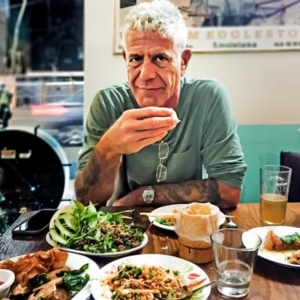 The late Anthony Bourdain takes a completely different approach to food presentation. He is a Power of Excitement character. He values exotic adventure, trying anything new, and experimenting with the outrageous and outlandish, while having a great sense of fun about the whole experience. He is a food explorer.
In his television series, No Reservations, Bourdain sought out exciting culinary adventures in some of the darkest, least accessible, or most dangerous places on the map. He and his television crew once had to be evacuated by the military from Beirut. An interview with Bourdain reports:
(Eating) the warthog anus was the worst and yes it did make him very sick. But it’s also his philosophy that you can’t refuse. This is all the food the hunters of the warthog have and they are giving it to you, how can you say no? There’s no corner of the globe too remote. No dish too disgusting to try … just once. No drink with too great an after burn. – Av Club Website
Power of Excitement characters believe life is a playground and a grand adventure. They are innovators, explorers, and merry pranksters. In whatever role these characters play, they are good-humored, a bit reckless, endlessly optimistic, and great fun. Bourdain sought out the strange, the unusual, or anything off the beaten track just to try something different. When he’s criticized, it is for being too extreme and experimental in his food presentation choices.
POWER OF LOVE
 Nigella Lawson is a Power of Love character. She is a food seducer. Cooking is a sensual pleasure and the opportunity to nurture. She is often described as being “sexy and flirty” while working with or presenting food. She celebrates her own voluptuous curves and says she takes her greatest joy in “feeding others”. Here is how she describes her philosophy in one of her books:
The trouble with much modern cooking is not that the food it produces is not good, but that the mood it induces in the cook is one of skin-of-the-teeth efficiency, all briskness and little pleasure. Sometimes that’s the best we can manage, but to others we want to feel not like a postmodern, post feminist, overstretched modern woman but, rather, a domestic goddess, trailing nutmeggy fumes of baking pie in our languorous wake. So what I’m talking about is not being a domestic goddess, exactly, but feeling like one. – Domestic Goddess
Lawson’s culinary efforts have been described as decadent, succulent, passionate, luscious, and lavish.
Lawson’s sexy roundness mixed with her speed-demon technique makes cooking dinner with Nigella look like a prelude to an orgy. – The New York TImes
Her appeal is further described here:
Women like her, she says, “because I’m not thin”, while men who lack the domestic skills to unwrap a chip supper can watch her licking a fingerful of her signature Slut Red Raspberries in Chardonnay Jelly and wonder what they have been missing. – The Telegraph
Power of Love characters, regardless of their appearance, are innately sensual and sexy. They are Earth Mothers or Nurturers regardless of their gender. In her many television shows like Nigella Bites and Forever Summer with Nigella, Lawson presents food as a comfort, a pleasure, and the abiding warmth of true sustenance. Cooking is her way of giving pleasure to others. When she’s criticized, it is for creating a kind of “Food Porn” that is too voluptuous or an overstuffed sensory feast.
POWER OF WILL
 Gordon Ramsay is a Power of Will character. He is a food bully. His show, Hell’s Kitchen (US) and Kitchen Nightmares (UK), takes aim at underperforming restaurants, which he, often in a screaming drill-sergeant manner, tries to whip into shape. He is an ex-trial-field footballer who has a big, bold, explosive personality. He is described here:
Ramsay bounds in, an aspirant Popeye with muscles bulging out of a blue T-shirt. He was named as television’s scariest personality in a Radio Times poll because of his talent for turning big men into trembling cry babies. – Waitrose.com
Here Ramsey is described in a review of an episode of his television show:
For the viewers it was just another example of the host’s bullish bluster – the sort of bad-mouthed, bare-knuckled assault that draws millions of viewers to Gordon Ramsay, turning him into one of the most famous people in America (and the UK).
Power of Will characters take what they want, fight for every inch of turf, refuse to show any weakness themselves, and pounce decisively on the weakness of others. They have a kill-or-be-killed mental framework for everything. They subscribe absolutely to the Law of the Jungle. They believe it is better to be feared than to be loved. They never want to be seen as “soft” or vulnerable. They show no mercy, and they expect none.
Gordon Ramsey sees food preparation as a battle on his television shows. Only the strong survive and thrive. When he is criticized, it is for being an arrogant bully who is insulting, abusive, and humiliating toward others.
POWER OF REASON
 Julia Child takes a completely different view of food and food presentation than all the other chefs above. She is a Power of Reason character. Her approach to cooking is a practical, feet-on-the-ground (in sensible shoes) mastering of basic techniques. She famously demystified and simplified the intricacies of French cooking for millions of readers and viewers in the 1960s. Child cataloged French cooking methods in her 700+ page encyclopedic Mastering the Art of French Cooking. She was a serious cook of good, solid food and disdained Julie Powell’s yearlong Julie and Julia project.
Publisher’s Weekly spoke to Judith Jones, Senior Editor and Vice President at Alfred A. Knopf, and Julia Child’s editor and confidante, who shared her recollection of Child’s feelings on Julie Powell’s blog:
Jones says Child did not approve of Powell’s cook-every-recipe-in-one-year project. The editor and author read Powell’s blog together (Julie and Julia, the book, was published a year after Child’s 2004 death). Julia said, “I don’t think she’s a serious cook.” Jones thinks there was a generational difference between Powell and Child. “Flinging around four-letter words when cooking isn’t attractive, to me or Julia. She didn’t want to endorse it. What came through on the blog was somebody who was doing it almost for the sake of a stunt. She would never really describe the end results, how delicious it was, and what she learned. Julia didn’t like what she called ‘the flimsies.’ She didn’t suffer fools, if you know what I mean.”
Like all Power of Reason characters, Child used a precise method to test, analyze, and catalog French recipes that could be duplicated by amateur chefs. Child respected French tradition while carefully explaining and making French technique accessible and understandable to the average cook.
She was extremely private and protective of her name. She valued her objectivity and refused to endorse any products during her lifetime. Child came to cooking very late and admitted to having no natural talent for the subject. But she was willing to put in the work to acquire skill and expertise.
Power of Reason characters see the world as a series of intellectual, practical, or scientific problems, dilemmas, or puzzles to be solved. They believe anything and everything can be explained rationally or solved logically. They examine the situation carefully, consult other expert opinions or past experiences, and put their minds to the issue in a thorough and objective fashion. Child was a beloved figure, but if she was parodied or mocked, it was for her personal and physical awkwardness, also a hallmark of Power of Reason characters.
POWER OF TRUTH
 Michael Pollan is another entirely different food personality. He is a Power of Truth character and a food investigator. Pollan was a professor of science and environmental journalism at the University of California, Berkeley, and the author of The Botany of Desire, The Omnivore’s Dilemma, and In Defense of Food: An Eater’s Manifesto. He is a frequent television guest and interview subject.
The Omnivore’s Dilemma, his most famous book, is described as follows:
Pollan follows each of the food chains that sustain us— industrial food, organic or alternative food, and food we forage ourselves— from the source to a final meal, and in the process develops a definitive account of the American way of eating. – Michael Pollan Website
(F)or Pollan, the final outcome is less important than the meal’s journey from the soil to the plate. His super-meticulous reporting is the book’s strength— you’re not likely to get a better explanation of exactly where your food comes from. In fact, the first quarter of the book is devoted to a shocking, page-turning exposé of the secret life of that most seemingly innocent and benign of American crops, corn. – NY Times Book Review
Power of Truth characters believe the world is filled with potential hidden dangers and concealed pitfalls. This character’s philosophy might be stated: “Things are never what they seem.” “Question everything.” “Watch out for secret agendas and hidden pitfalls.”
These characters ask: “What does society demand, expect or value?” and then often set out to debunk or disprove the answer. They are compelled to uncover the concealed nature or (often rotten) underbelly of things. When Pollan is criticized, it is for being too suspicious of and employing scare tactics about the hidden dangers of ordinary foods.
POWER OF AMBITION
 Rachel Ray is a food entrepreneur and pitchwoman. She is a Power of Ambition character. She has a can-do spirit, high energy level, relentlessly promotes her personal brand, and endorses everything from dog food to fast food sandwiches and coffee. Although most chefs have endorsement contracts, Ray has taken her promotional activities to a whole new level.
Her approach to food is populist– sloppy, loud, cheerful, and accessible. Ray’s common-touch persona is a multimillion-dollar enterprise with four hit Food Network shows, 12 million copies of her 13 bestselling cookbooks, a self-titled monthly magazine, an Emmy-winning daily talk show, and a vast array of branded kitchen and home products. Her technique is described:
Rachael cuts corners and uses boxed ingredients. She abhors specialty ingredients. Her dishes only use what she can find at the local supermarket. She has received a lot of bad press for this, from the media as well as chefs.
In Rachael’s defense, this is reality for most Americans. As much as we’d like to whip up a gourmet meal every night, we simply don’t have the time. – About.com
Power of Ambition characters value popularity, achievement, and financial success. They are opportunists and naturally gravitate toward anything that will advance their personal agenda, enhance their popularity, or further their desired aims. They are adept at cutting corners, taking shortcuts, and doing things the quick and easy way. When Ray’s criticized, it is for the relentless commercialization of herself and her cheap, fast, and cheerful approach to food; some say she brings cooking down to the lowest common denominator, others say she has a friendly common touch.
POWER OF IMAGINATION
 Benjamin Christie is a Food Ambassador. He is a Power of Imagination character. In the biography section on his website, he explains he didn’t like the heat, pressure, and conflict in a commercial restaurant kitchen. His approach to food involves bringing the generally undervalued cuisine of Australia and its indigenous ingredients to the attention of world markets. Here is how he explains the purpose of his organization on his website:
The Chefs Network is a food media news portal blog platform… working together for the best interests of the culinary industry, supporting those that choose to follow in our footsteps. The Chefs Network is a network of Chefs of all culinary styles & cultures. and offers networking opportunities, an inside link to professionals in the culinary industry, insight and information to foster increased culinary development, excellent opportunities for professional and personal development and lasting relationships with colleagues in the culinary industry.
Christie has a genial, supportive, and non-judgemental persona. He is a simple man with simple tastes. When asked on his website what his favorite restaurants are and if people get nervous cooking for him, he says:
I like a seafood restaurant which offers a simple grilled fish or prawns. I’ve had people paranoid about cooking for me because I am a chef, but it doesn’t bother me in the slightest. (I’m) never critical.
Power of Imagination characters dislike and avoid conflict, confrontation, and aggressive behavior. They hate to argue, row, or fight. These characters prefer to bring others together in working toward a unifying goal. They naturally attract diverse individuals who share a common purpose despite significant outward differences, including conflicting agendas or opposing points of view.
These characters are patient, understanding, and appreciative of those who are often overlooked, ignored, or dismissed. They are extremely tolerant and inclusive. If Christie is criticized, it is probably for not having a specific point of view or a more critical sensibility.
NINE CHARACTER TYPES
The Nine Character Types demonstrate how it is possible to engage in the same profession, have the same general interests, and do very similar jobs in a very personally distinctive manner. The most interesting dramas and the most compelling reality shows feature individuals with clear, sharply defined points of view and a very specific philosophy concerning how and why they do what they do. Each character should approach life, love, and work in a very individual way.



No comment yet, add your voice below!